Advancing the Profession of Business

An image of a business meeting as two associates shake hands to greet one another

To enhance the profession of business and communities

To accelerate the development of leaders of character who get results with integrity

To be a recognized thought leader in the education, development, and practice of business leadership and character


We are all leaders responsible for the mission, leading with integrity, being transparent, and creating an open, inclusive, innovative, and safe environment


We are dedicated to delivering excellent results on all endeavors that move the Center towards its mission and purpose and being continuous learners

We are committed to advancing the knowledge pertaining to ethical leadership and character development and work to lead the conversation on these topics within our community

We are dedicated to translating knowledge into products and tools leaders can use to enhance their leadership effectiveness and abilities to build ethical organizations

We are one team โ€“ we trust each other and stakeholders, assume positive intent, take responsibility to coordinate efforts, act out of loyalty, and place the mission and teammates first

our primary focus is the integration of ethical leadership and character strengths into courses, academic programs, co- and extra-curricular activities, and faculty and staff development programs within the School of Business

We are dedicated to creating and publishing new knowledge regarding ethical leadership and character development in the top journals

We also have a responsibility to assist in the development of leaders of character within the Wake Forest and local communities in the spirit of Pro Humanitate

Meet Our Team

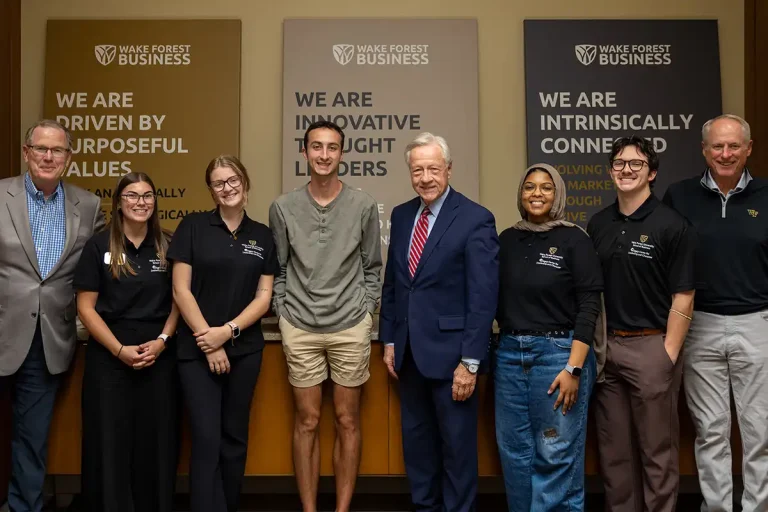
Advancing the Profession of Business, the AFCLC Team is driven by a commitment to our Purpose, Mission, and Vision.

Profile image of Dr. Patrick J Sweeney

Dr. Patrick J Sweeney

Professor of the Practice of Management & Executive Director, Allegacy Center for Leadership and Character

Profile image of Lyn B. Myers

Lyn B. Myers

Senior Operations Manager, Allegacy Center for Leadership and Character

Profile image of Amanda Beck

Amanda Beck

Adminsitrative Coordinator, Allegacy Center for Leadership and Character

Profile image of Dr. Sean Hannah

Dr. Sean Hannah

J. Tylee Wilson Chair in Business Ethics; Senior Research Associate, ACLC; Professor

Profile image of Greg Stewart

Greg Stewart

Thomas K. Hearn, Jr. Professor; Research Associate, ACLC; Professor

Profile image of Dr. John Sumanth

Dr. John Sumanth

James Farr Faculty Fellow in Leadership and Organizational Development; Associate, ACLC; Associate Professor

Profile image of Professor Stephen Smulowitz

Professor Stephen Smulowitz

Dale and Karen Sisel Professor; Research Associate, ACLC; Associate Professor

Profile image of Dr. Kenny Herbst

Dr. Kenny Herbst

Board of Visitors Faculty Fellow in Marketing; Associate Professor

Profile image of Jeff Triplette

Jeff Triplette

Executive In Residence, Allegacy Center for Leadership and Character

Profile image of Adam Holtzschue

Adam Holtzschue

Executive Affiliate, Allegacy Center for Leadership and Character

Profile image of Cathy Pace

Cathy Pace

Executive Affiliate, Allegacy Center for Leadership and Character

Profile image of Dave Clawson

Dave Clawson

Executive Affiliate, Allegacy Center for Leadership and Character

Profile image of Ann Johnston

Ann Johnston

Executive Affiliate, the Allegacy Center for Leadership and Character

Our Publications

In the course of pursuing the enhancement of the profession of business and communities, the staff, executives in residence, and research associates of the AFCLC have published an extensive library of research. This research is available to our members.
Each publication is organized according to three general categories of interest: Leadership, Leader Development, and Organizational Development. Explore the breadth of each category below:

A Growth Strategy that Creates and Protects Value.

Hofmann, D. A., & Sumanth, J. J.

Harvard Business Review
Spiritual fitness: A key component of total force readiness.

Sweeney, P.J., Rhodes, J.E., & Boling, B.

Armed Forces Journal, 66(3), 35-41.
The domain of the human spirit.

Sweeney, P.J., Hannah, S.T., & Snider, D.M.

Forging the warriorโ€™s character: Moral precepts of the cadet prayer (pp. 55-99). D. M. Snider (Project Director) & L. J. Matthews. Sisters, OR: Jerico, LLC.
Character development through spiritual leadership.

Sweeney, P.J., & Fry, J.

Consulting Psychology Journal: Practice and Research, 64(2), 89-107.
Leadership, discipline, and cohesion.

Sweeney, P.J.

A warriorโ€™s guide to psychology and performance: What you should know about yourself and others. Editors: G. Mastroinni, B. Palmer, D. Penetar, & V. Tepe. Dulles, VA: Potomac Books Inc. 89-107.
Why good guys finish last: The role of justification motives, cognition, and emotion in predicting retaliation against whistleblowers.

Sumanth, J.J., Mayer, D.M., & Kay, V.S.

Organizational Psychology Review, 1(2), 165-184.
Power language: Effective communication for executive development.

Shelton, K.R.

Organizational Psychology Review, 1(2), 165-184.
Building spiritual fitness in the Army: An innovative approach to human development.

Pargament, K.I., & Sweeney, P.J.

American Psychologist, 66 (1), 58-64.
Leader development for dangerous contexts.

Palmer, N. F., Hannah, S. T., & Sosnowik, D. E.

Leading in dangerous contexts, P. J. Sweeney & P. B. Lester, Editors. Naval Institute Press: Annapolis, MD.
Leader development and self-awareness in the Army bench project.

Oโ€™Neil, D., Sweeney, P.J., Ness, J., & Kolditz, T.

Leadership lessons from West Point, D. Crandall , Editor. (pp.107-130). San Francisco: Jossey-Bass.
Identity development during the college years: Findings from the West Point longitudinal study.

Lewis, P., Forsythe, G. B., Sweeney, P.J., Bartone, P., Bullis, C., & Snook, S.

Journal of College Student Development, 46 (4), 357-373.
Mentoring impact on leader efficacy development: A field experiment.

Lester, P., Hannah, S.T., Harms, P., Vogelgesang, G. & Avolio, B.J.

Academy of Management Learning and Education, 10, 409-429.
Developing courage in followers: Theoretical and applied perspectives.

Lester, P. B., Vogelgesang, G. R., Hannah, S. T., & Kimmey, T.

The Psychology of Courage Modern Research on an Ancient Virtue, C. Pury and S. Lopez, Editors (pp. 187-208). American Psychological Association.
Different hats, different obligations: Plural occupational identities and situated moral judgments.

Leavitt, K., Reynolds, S.J., Barnes, C., Schilpzand, P., & Hannah, S.T.

Academy of Management Journal, 55, 1316-1333.
The moral self: A review and integration of the literature.

Jennings, P. L., Mitchell, M.S. & Hannah, S.T.

Journal of Organizational Behavior, 36(51) S104-168.
Leader ethos: How character contributes to the social influence of the leader.

Jennings, P. L. & Hannah S. T.

Leader Interpersonal Skills: The Soft Skills of Leadership; Riggio, R. (Editor) Routledge, Taylor Francis.
Experience, knowledge, and military leadership.

Horvath, J.A., Forsythe, G.B., Bullis, R.C., Sweeney, P.J., Williams, W.M., McNally, J.A., Wattendorf, J.M., and Sternberg, R.J.

Tacit knowledge in professional practice: Research and practitioner perspectives (pp. 39-58). Robert J. Sternberg and Joseph A. Horvath (Editors), Hillsdale, NJ: Lawrence Erlbaum Associates. โ€‹
Leader development and the dark side of personality.

Harms, P.D., Spain, S.M., & Hannah, S.T.

Leadership Quarterly, 22, 495-509.
A framework for examining leadership in extreme contexts.

Hannah, S.T., Uhl-Bien, M., Avolio, B.J., & Cavarretta, F.L.

Leadership Quarterly, 20, 897-919.
Duty orientation: Theoretical development and preliminary construct testing.

Hannah, S.T., Jennings, P.L., Bluhm, D., Peng, A.C., & Schaubroeck, J.M.

Organizational Behavior and Human Decision Processes, 123(2) 220-238.
Tactical military leader requisite complexity: Toward a reference structure.

Hannah, S.T., Jennings, P.L., & Nobel, O.B.

Military Psychology, 22, 412-449
Advancing a research agenda for leadership in dangerous contexts.

Hannah, S.T., Campbell, D.J., & Matthews, M.D.

Military Psychology, 22, 157-189.
Moral maturation and moral conation: A capacity approach to explaining moral thought and action.

Hannah, S.T., Avolio, B.J., & May, D.R.

Academy of Management Review, 36(4), 663-685.
The locus of leader character.

Hannah, S.T., & Avolio, B.J.

Leadership Quarterly, 22, 979-983.
Leader character, ethos, and virtue: Individual and collective considerations.

Hannah, S.T., & Avolio, B.J.

Leadership Quarterly, 22, 989-994.
Ready or not: How do we accelerate the developmental readiness of leaders?

Hannah, S.T., & Avolio, B.J.

Journal of Organizational Behavior, 31, 1181-1187.
Leader ethos and big-C character.

Hannah, S.T. & Jennings, P.L.

Organizational Dynamics, 42, 8-16.
Moral potency: Building the capacity for character-based leadership.

Hannah, S.T. & Avolio, B.J.

Consulting Psychology Journal, 62, 291-310.
Leader self-structure: A framework for positive leadership.

Hannah, S., Woolfolk, R. L., & Lord, R. L.

Journal of Organizational Behavior, 30, 269-290.
Toward a courageous mindset: The subjective act and experience of courage.

Hannah, S., Sweeney, P., & Lester, P.

Journal of Positive Psychology, 2, 129-135.
The courageous mindset: A dynamic personality system approach to courage.

Hannah, S. T., Sweeney, P. J., & Lester, P. B.

The Psychology of Courage: Modern Research on an Ancient Virtue (pp. 125-148). C. Pury & S. Lopez (Editors), American Psychological Association.
Frameworks of moral development and the West Point experience: Building leaders of character for our Army and the Nation.

Hannah, S. T., & Sweeney, P.

Forging the warrior’s character. D. M. Snider & L. J. Matthews (Editors), New York: McGraw Hill.
Leadership in military and other dangerous contexts: Introduction to the special topic issue.

Campbell, D.J., Hannah, S., & Matthews, M.D.

Military Psychology, 22, 1-14.
Differentiating transformational and non-transformational leaders on the basis of neurological imaging.

Balthazard, P.A., Waldman, D.A., Thatcher, R.W., & Hannah, S.T.

Leadership Quarterly, 23(2), 244-258.
Leader developmental readiness.

Avolio, B. J., & Hannah, S.

Industrial and Organizational Psychology: Perspectives on Science and Practice, 2, 284-287.
Developmental readiness: Accelerating leader development.

Avolio, B. J., & Hannah, S.

Consulting Psychology Journal, 60, 331-347.
Wisdom: A strength of character to reduce stress and facilitate creativity.

Avey, J., Luthans, F., Hannah, S.T., Sweetman, D., & Petersen, C.

Human Resource Management Journal, 22(2), 165-181.

Psychological and neurological predictors of abusive supervision.

Waldman, D.A., Wang, D., Hannah, S.T., Balthazard, P.B., & Owens, B.

Personnel Psychology. (Forthcoming)
Bolstering managers’ resistance to temptation via the firm’s commitment to corporate social responsibility.

Beaudoin, C., Cianci, A., Hannah, S.T., & Tsakumis, G.

Journal of Business Ethics. Vol. 157, No. 2
Moral identity complexity: Situated morality within and across work and social roles.

Hannah, S.T., Thompson, R, & Herbst, K.

Journal of Management. Vol. 46, Issue 5
Staying after the storm: How transformational leadership relates to follower turnover intentions in extreme contexts.

Eberly, M.B., Bluhm, D.J., Guarana, C., Avolio, B.J., & Hannah, S.T.

Journal of Vocational Behavior. Vol. 102, 72-85
You may not reap what you sow: How employees’ moral awareness minimizes ethical leadership’s positive impact on workplace deviance.

Gok, K., Sumanth, J.J., Bommer, W.H., Demirtas, O., Arslan, A., Eberhard, J., Ozdemir, A.I., & Yigit, A.

Journal of Business Ethics, 1-21.
Neuroscience of moral cognition and conation in organizations.

Hannah, S.T., & Waldman, D.A.

Organizational Neuroscience, D.A. Waldman & P.A. Balthazard (Editors), Bingley, UK: Emerald Publishing.
The moderated influence of ethical leadership, via meaningful work, on followers’ engagement, organizational identification, and envy.

Demirtas, O., Hannah, S.T., Gok, K., Arslan, A., Capar, N.

Journal of Business Ethics, 10, 1-19.
When “it depends” amounts to more than simple contingent relationships: Three canonical forms of inversions.

Cavarretta, F.L., Trinchera, L., Choi, D.O., & Hannah, S.T.

Journal of Organizational Behavior, 37, 933-945.
A neurological and ideological perspective of ethical leadership.

Waldman, D.A., Wang, D., Hannah, S.T., & Balthazard, P.B.

Academy of Management Journal, 59, 5.
Trust and influence in combat: An interdependence model.

Sweeney, P.J., Thompson, V. D., & Blanton, H.

Journal of Applied Social Psychology, 39 (1), 235-267.
Leading in dangerous situations: An overview of the unique challenges.

Sweeney, P.J., Matthews, M.D.

Leading in dangerous situations: A handbook for the armed forces, emergency services, and first responders (1-16). Annapolis, MD: Naval Institute Press.
Building moral strength: bridging the moral judgment-action gap.

Sweeney, P.J., Imboden, M.W., & Hannah, S.T.

New Directions for Student Leadership. Special Issue: Developing Ethical Leaders. 146, 17-33.
A holistic approach to leading in dangerous contexts.

Sweeney, P.J., & Matthews, M.D.

Leading in dangerous situations: A handbook for the armed forces, emergency services, and first responders (371-389). Annapolis, MD: Naval Institute Press.
Do soldiers re-evaluate trust in their leaders prior to combat operations?

Sweeney, P.J.

Military Psychology, 22: (Suppl.1) S70-S88.
Trust: The key to combat leadership.

Sweeney, P.J.

Leadership lessons from West Point (pp. 252-277). D. Crandall (Editor), San Francisco: Jossey-Bass.
Trust: A critical factor in leadership.

Sweeney, P.J.

Field Artillery Journal, May-June, 18-21.
High impact leadership: The positive effects of authentic moral leadership on followers.

Sweeney, P.J. & Hannah, S. T.

Forging the warriorโ€™s character: Moral precepts of the cadet prayer (pp. 163-199). Sisters, OR: Jerico, LLC.
Embedding ethical leadership within and across organizational levels.

Schaubroeck, J., Hannah, S.T., Avolio, B.J., Kozlowski, S.W., Lord, R.L., Trevino, L.K., Peng, A.C., & Dimotakas, N.

Academy of Management Journal, 55(5), 1053-1078
Soldiers’ negotiations in combat areas: The effects of role clarity and concern for members of the local population.

Nobel, O.B., Campbell, D.J., Hannah, S.T., & Wortinger, B.

International Journal of Conflict Management, 21, 202-227.
A framework for understanding leadership and individual requisite complexity.

Lord, R.L., Hannah, S.T., & Jennings, P.L.

Organizational Psychology Review, 1(2), 104-127.
The moralities of obligation and aspiration: Towards a concept of exemplary military ethics and leadership.

Jennings, P.L., & Hannah, S.T.

Military Psychology, 23, 1-22.
Leadership in action teams: Team leader and members’ authenticity, authenticity strength, and performance outcomes.

Hannah, S.T., Walumbwa, F.O., & Fry, J.

Personnel Psychology, 64, 771-801.
Joint influences of individual and work unit abusive supervision on ethical intentions and behaviors: A moderated mediation model.

Hannah, S.T., Schaubroeck, J., Peng, A.C., Lord, R.L. Trevino, L. K., Kozlowski, S.W.J., Avolio, B.J. Dimotakis, N., & Doty, J.

Journal of Applied Psychology, 98(4), 579-592.
Leadership and collective requisite complexity.

Hannah, S.T., Lord, R.L., & Pearce, C.L.

Organizational Psychology Review, 1(3), 104-127.
The relationships between authentic leadership, moral courage, and ethical and pro-social behaviors.

Hannah, S.T., Avolio, B.J., & Fred, W.O.

Business Ethics Quarterly, 21(4), 555-578.
Leadership efficacy: Review and future directions.

Hannah, S., Avolio, B. J., Luthans, F., & Harms, P.

Leadership Quarterly, 19, 669-692.
Moral leadership: Explicating the moral component of authentic leadership.

Hannah, S. T., Lester, P. B., & Vogelgesang, G. R.

Authentic Leadership Theory and Practice: Origins, Effects, and Development (pp. 43-82). W.B. Gardner & B. J. Avolio (Editors), Monographs in Leadership and Management. Elsevier/JAI Press.
Complex adaptive leadership: Defining what constitutes effective leadership for complex organizational contexts.

Hannah, S. T., Eggers, J. H., & Jennings, P. L.

Knowledge driven corporation: Complex creative destruction. LMX Leadership: The Series. G. B. Graen & J. A. Graen (Editors), Volume VI (pp. 79-124). Charlotte, NC: Information Age Publishing.
Authentic Leadership Theory: A theory primer for students of leadership.

Hannah, S. T., Avolio, B. J., & Luthans, F.

Special Readings in Military Leadership, 2d Ed. McGraw Hill.
A cognitive affective processing explanation of positive leadership: Toward theoretical understanding of the role of psychological capital.

Hannah, S. T., & Luthans, F.

Affect and Emotion: New Directions in Management Theory and Research, Volume 7 of Research in Management (pp. 95-134). Charlotte, NC: Info Age Publishing.
Veritable authentic leadership: Emergence, functioning, and impacts.

Hannah, S. T., & Gardner, W. L.

Authentic Leadership Theory and Practice: Origins, Effects, and Development (pp. 3-42). Monographs in Leadership and Management. Elsevier/JAI Press.
Authentic leadership: The heart of high impact leadership.

Hannah, S. T.

Leadership Lessons from West Point (pp. 88-106). Jossey-Bass, San Francisco.
Leadership in the profession of arms.

Hannah, S. T. & Sowden, W.

Oxford Handbook of Leadership. Oxford University Press: New York.
Debunking the false dichotomy of leadership idealism and pragmatism: Critical evaluation and support of newer genre leadership theories.

Hannah, S. T, Sumanth, J. J., Lester, P., & Cavarretta, F.

Journal of Organizational Behavior, 35, 598-621.
Mission possible: The performance of prosocially motivated employees depends on manager trustworthiness.

Grant, A.M., & Sumanth, J.J.

Journal of Applied Psychology, 94, 927-944.
The effects of authentic leadership on followers’ ethical decision-making in the face of temptation: An experimental study.

Cianci, A., Hannah, S., Roberts, R. & Tsakumis, G. T.

The Leadership Quarterly. 25(3) 581-594.
100 years of leadership intervention studies: A meta-analysis.

Avolio, B.J., Reichard, R.J., Hannah, S.T., Walumbwa, F.O., & Chan, A.

Leadership Quarterly, 20, 764-784.
Executive summary: 100 year review of leadership interventions.

Avolio, B. J., Reichard, R. J., Hannah, S., Walumbwa, F. O. , & Chan, A.

Leadership Review, 5, 7-13.

Best practice recommendations for scale construction in organizational research: The development and initial validation of the Character Strength Inventory (CSI).

Wright, T. A., Quick, J. C., Hannah, S. T., and Blake Hargrove, M.

Journal of Organizational Behavior.
The proposed change strategy to embedded energy stewardship into the Armyโ€™s culture.

Sweeney, P.J. & Horner, D.H.

U. S. Army Logistics Innovation Agency, Fort Belvoir, VA.
The role of peer respect in linking abusive supervision to follower outcomes: Dual moderation of group potency.

Schaubroeck, J.M., Peng, A.C., & Hannah, S.T.

Journal of Applied Psychology, 101(2), 267-78.
Developing trust in leaders and peers, relational identity, and the acceleration of organizational identification during entry.

Schaubroeck, J., Peng, A.C., & Hannah, S.T.

Academy of Management Journal, 56(4), 1148-1168.
Group well-being: Morale from a positive psychology perspective.

Peterson, C., Park, N., & Sweeney, P.J.

Applied Psychology: An International Review, 57, 19-36.
Advertisement disclaimer speed and corporate social responsibility: ” Costs” to consumer comprehension and effects on brand trust and purchase intention.

Herbst, K., Hannah, S.T., & Allen, D.

Journal of Business Ethics, 117(2), 297-311.
The psychological and neurological bases of leader self-complexity and effects of adaptive decision-making.

Hannah, S.T., Balthazard, P.A., Waldman, D.A., Jennings, P.L., & Thatcher, R.W.

Journal of Applied Psychology, 98(3), 393-411.
Leader self and means efficacy: A multi-component approach.

Hannah, S.T., Avolio, B.J., Chan, A., & Walumbwa, F.

Organizational Behavior and Human Decision Processes, 118, 143-161.
A multilevel approach to building and leading learning organizations.

Hannah, S., & Lester, P.

Leadership Quarterly, 20, 34-48.
Transforming followers’ value internalization and role self-efficacy: Dual processes promoting performance and peer norm-enforcement.

Hannah, S.T., Schaubroeck, J.M., & Peng, A.C.

Journal of Applied Psychology. 101(2) 252-66
Appeasing equals: Lateral deference in organizational communication.

Fragale, A.R., Sumanth, J.J., Tiedens, L.Z., & Northcraft, G.B.

Administrative Science Quarterly, 57, 373-406.
Owning our Army ethic.

Case, C., Underwood, R., & Hannah, S.T.

Military Review, Nov-Dec, 2-9.