Finding Success Beyond the Comfort Zone

Nicole Ma (MSBA ‘18), Senior Manager, Data Science, Visa
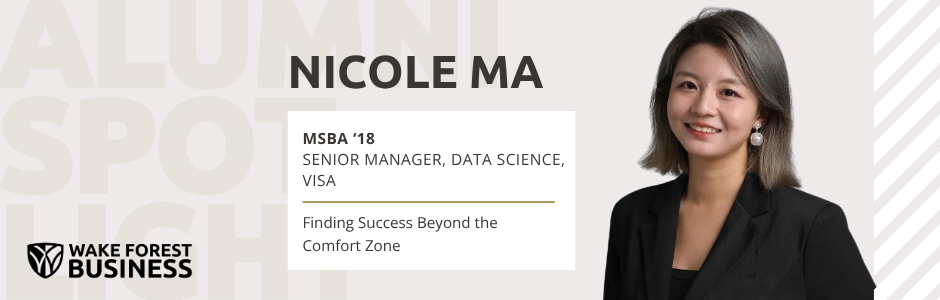
With a background in economics and finance, what made Wake Forest’s MS in Business Analytics program the right next step for your career goals? When I was researching graduate schools, my goal was to stay in the United States and gain some professional experience to start my career. It happened to be the same time when big data and analytics were becoming hot topics. I had never been in a business setting and wanted to have a more in-depth American education experience from a top business school. When I read all the positive feedback about career services, I was very interested in Wake Forest. I interviewed, and the application process was very smooth. I had a virtual visit and talked with John White from the Enrollment Management team. Everyone was super welcoming, and the culture was a fit. It just clicked!
Looking back at the MSBA curriculum, what specific technical skills or business frameworks from Wake Forest proved most valuable during your transition into industry? I worked for PwC for three years after graduation. In terms of technical skills, SAS was heavily involved in our curriculum, which really helped me in my first job. While at PwC, I was interacting with a lot of banks and insurance companies, and SAS was still heavily used. I think that’s likely one of the reasons I was hired. It was helpful for me to know SAS because not all graduate schools at the time taught it. At Wake Forest, we were not only taught SAS, but also Python and R coding, so we had an advantage of knowing all the languages.
I took a financial analysis course taught by Dr. Jon Pinder. Even though it was taught in Excel, one of the major topics that we covered was the importance of having an automation mindset for all the models that you build. You might be facing millions of records of data in the future and your Excel file might crash, or there may be manual work with cleaning the data or adjusting the formulas. You want to push for efficiency and improve by writing loops and using functions to automate them the best that you can, which saves time for something more valuable.
You started your post-MSBA career at PwC in risk modeling. What was the biggest learning curve moving from graduate school into high-stakes risk consulting – any stumbles or lessons learned? Since I’m an international student, I try especially hard to minimize language barriers. Being a consultant early on in my career, both culturally and language-wise, was a challenge for me compared to my peers. In particular, with technical topics, I understand them well, but presenting and communicating them with different audiences can be challenging. Especially in a consulting setting where everyone is extra social and outgoing— that intimidated me in the beginning. I had to go back and think about what business school had taught me; I thought back to the skills I learned on how to give presentations, how to evaluate an audience, and how to present the topics differently [based on the audience]. I definitely practiced a lot in private before I went into client meetings! This equipped me with some of the communication skills in my toolbox.
As a Senior Manager leading data science initiatives at Visa, what balance do you strike between staying technical and managing strategic business outcomes? At my current level at Visa, we have different types of data science teams. For my team, I support the internal business functions, which means my team works closely with the product and the operations areas. To lead a team like this, I need to be closer to the business-side. For example, if I have a machine learning model and I keep talking about the statistics and the modeling side of things, I’m not speaking their language. If the information doesn’t resonate, then they don’t know why they should be internally hiring me to influence their decision. The biggest balance is how I speak their language. For every model we build, I always try to pin down the final opportunity cost or the opportunity dollar amount that I can bring to the table. Talking about the model accuracy, rather than what percentage of purchasing volume increase this model will bring, that’s when I can attract their attention. Then the collaboration really starts to work!
As a bilingual alumna who successfully navigated international education and built a standout career in the U.S. tech and finance sectors, what advice do you have for current students aiming for similar roles? I have two suggestions. The first one is to always try different things before it’s too late. In my first job in consulting, I rotated to different teams—not everyone has the same opportunity. Early on in your career, you need to really learn, talk to different people, talk to different functions, and really learn the specific areas that interest you or that you are good at. The more you try, the more you talk to people, the sooner you will figure that out, and that will benefit you.
Secondly, quite honestly, is to fake it until you make it. I definitely practiced privately a lot. I am by nature very shy, and I’m an introvert. In a business setting, you have to talk to people and network; it’s not easy, but sometimes you just have to keep doing it and fake it until you make it. Learn how to push yourself out of your comfort zone. I feel like business school was definitely not within my comfort zone; I came to school wanting to learn more technical, analytical and computer skills, but then I ended up benefiting more from the soft skills I learned there. Nobody else is going to teach you these skills again; business school is a centralized period where you learn these skills to put in your toolbox. When I graduated and started working, I realized how valuable the experience really was!
When you look back on your journey from international student to senior manager at a Fortune-500 global enterprise, what is the ultimate legacy or mark you hope to leave on the analytics community and the teams you lead? For me, it’s a sense of purpose that drives me. I want to see that the projects I do actually make a direct impact, which is what led me to switch from PwC to Visa. I transitioned from consulting to a role where I’m participating in some of the decisions and advising others who make decisions. My role at PwC was more back-end (risk evaluation) and not directly revenue-generated, so I didn’t see the results as much. In my current role, there’s a lot of day-to-day functions and advertisements that people see that were projects I was actually involved with. For example, during COVID our team helped increase the tap-to-pay penetration for the North America market. My team’s analysis was heavily involved in those decisions, which is very rewarding. I live in DC right now and can tap my credit card to ride the metro; whenever people comment about that, I feel a great sense of accomplishment.
Ten years down the road you want to continue to make an impact—what is your dream job? I love traveling and consider myself a traveler. For the payment industry, travel is already overlapping with a big chunk of projects I work on because of the cross-border analysis at merchant levels. For example, when you travel, which merchants do you turn to? Do you use online travel agencies like Bookings.com or Expedia? I’m already working with some of those merchants, which I really enjoy. If I dream bigger, I would like a larger role with an international travel company or a company that is heavily involved in traveling. I see a huge opportunity with how data science and AI can power these industries to bring more people to travel and ultimately increase mobility all over the world.
Is there a personal mantra that defines you or a personal philosophy that you live by? Living in the moment. I obviously came from a more traditional Asian culture. But ever since COVID, I have really changed. In my first job, I worked and traveled a lot for work, so there wasn’t really time for me to enjoy life and go on vacation. I always thought that later on I would have more time and more money, so then I can do that. Once COVID hit, that changed a lot of things. Now, I feel like I’m more of a “work hard, play hard” type of person. If you prioritize and manage your time and optimize your efficiency well, you can achieve everything at the same time – you don’t have to wait. At this point, I am enjoying life while I still can.
Spotlight interview conducted by Associate Director of Alumni Engagement, Carrie Ross.
