Chasing 50 States and Executive Success

Lucas Prillaman (MSA ‘17), Chief Operating Officer, Broward Grove
Many of our current accounting students aspire to work at firms like PwC. What advice do you have for them on navigating the intensity of those early years in public accounting?
After graduating from the MSA program, I worked at PwC for three years in their tax group. While I may not have realized it then, the biggest piece of advice I can share now is to stay curious. I’m always looking to understand how curious a candidate is and make sure they’re not afraid to ask questions of both themselves and others. Curiosity helped me succeed at Wake Forest and ultimately become a lifelong learner where I continue to find areas of growth. Also, advocate for yourself and don’t be afraid to ask. Looking back at my early career, I was always trying to figure out what’s next. Show initiative, ask for what you want and promote your own value.
After PwC, you transitioned into the family office space and are now a Chief Operating Officer at Broward Grove. For students who might not be familiar with it, how would you describe the unique world of wealth and family office management?
We manage everything a high-net-worth family needs outside of direct investment management, while still being involved in the investment governance function and working with outsourced CIOs. Our world bridges technical financial management—like tax consulting, cash flow analysis and liquidity—with legacy building. We oversee philanthropic endeavors to maximize “social ROI” in their communities and around the world.
I spend the bulk of my time working on the financial capital piece of the picture. I have conversations with families about stewardship and what that may look like for their family legacy. At the end of the day, we are all just people hoping to find joy and fulfillment in life. We help families that are community- and philanthropic-minded, who want to see their dollars go back into their communities and impact society in a meaningful way.
Moving from a massive public accounting firm to an executive role in a private firm requires a shift in mindset. What has been the most exciting—and the most challenging—part of that transition?
Back in 2021, the company only had four employees. Now we’re a team of 11, with a four-person executive team and continuing to grow. The greatest joys in my role have been working closely with families. We view the tax season as a confirmation exercise rather than a more traditional “fact finding mission” because we have such strong relationships with our families and already know the ins and outs of their financial capital. We serve multigenerational families and have the privilege of knowing them across every stage of life, from the eldest generation to the youngest. The relationships we build with these families mean a great deal to us. We celebrate meaningful milestones alongside them, and over time, we often come to feel like an extension of the family. That level of trust and connection is incredibly rewarding.
Looking back at your time in the MSA program, is there a specific class, professor, or late-night study session that still sticks with you today?
Because I was on the Tax Track, I spent a lot of time with Professor Willis, who is a tax professor. His style of teaching was very relatable. Even to this day, I speak to his classes and, as a result, our relationship has turned into more of a mentorship. We exchanged emails just today! We grab lunch and swap tax tidbits, and I keep him updated on my career here in Charlotte. I recently hired two Wake Forest MSA alumni, and Professor Willis was a reference for both of them.
You currently serve as a leader (chair-elect) on the Alumni Council. Why is giving back your time to the School of Business so important to you, and how has the alumni network supported you in your career?
In my senior year at Guilford College, I had a professor ask what I was doing after graduation. He suggested the Wake Forest MSA program to me and I decided if I was admitted, I would go. I have thrived ever since!
Today, being a part of the Wake Forest School of Business Alumni Council gives me the opportunity to interact with students, share stories and talk about my field. I’ve had the opportunity to work with and mentor students who may be considering similar careers to mine; it gives me the opportunity to help them navigate the industry and serve as a point of contact for the alumni network. I feel like it is my way to further encourage students and alumni to take a chance and bet on themselves.
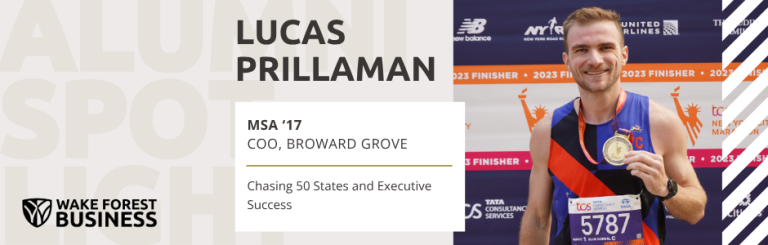
Word has it that you are an avid marathon runner! How did that personal commitment to running begin, and how many races have you checked off so far? Tell us more!
I played collegiate soccer at Guilford College up until senior year when I got a bad ankle sprain and had to sit out my last few games. Because of that injury, I had the opportunity to walk on to the track team – and I thrived in that environment.
So far, I’ve run 11 marathons across 10 states and two countries. My next marathon will be in Honolulu this December. Seeing all of these different towns and cities I wouldn’t otherwise visit has been one of the best parts. For example, Duluth, Minnesota is a tiny college town, and the marathon takes you right by Lake Superior, where you can see the finish line across the lake from the starting line. Running brings out a sense of community within me. My goal is to finish 50 marathons across 50 states. And, I’m a sucker for punishment, so I want to finish all the major marathons across the world (Boston, Chicago, London, Tokyo, Sydney, etc.).
Since this is for our summer newsletter, what does the perfect, relaxing summer weekend look like for you when you’re completely off the clock?
The perfect summer weekend for me would include a long run near the water on a Saturday morning (before it gets too hot), followed by coffee, a pastry and hanging out by the pool with my wife.
Anything else you’d like to share with the School of Business alumni family?
Being involved in my community has made a big difference for my personal development and career. The importance of giving back was modeled for me from a young age. Being a part of the Wake Forest School of Business Alumni Council has been a great way to give back to others. Outside of that work, I’ve coached five seasons of Let Me Run, a program that promotes building character and community for boys becoming young men. Working with Let Me Run blends multiple passions of mine, and I get to do it by staying active and spending time outside.
Spotlight interview conducted by Alumni Council member Emily Batista (MSBA ‘18).
