Building Charlotte’s Future Through Leadership and Public Good

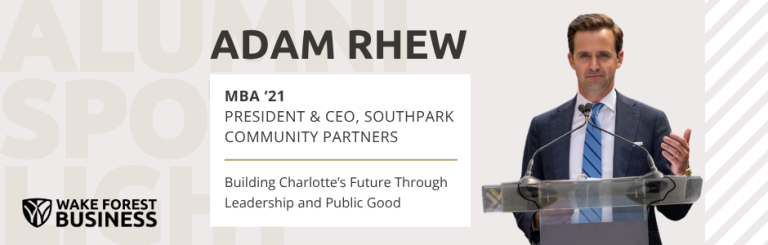
Adam Rhew (MBA ’21), President & CEO, SouthPark Community Partners
You’ve described the Charlotte Evening MBA program as a game-changer for your career. What changed most in the way you approached leadership?
I came into the program thinking an MBA was going to help me round out gaps in my skill set. My undergraduate degrees are in journalism and political science, so I was a very traditional liberal arts major. I thought I needed finance and other quantitative skills to get where I wanted to go in my career.
What surprised me was how much value I got from the leadership- and strategy-related curriculum. In my role today, so much of what I do is influencing without authority. It’s about getting a whole bunch of people to hold hands and walk in the same direction, and I can’t imagine better preparation for that than Wake Forest’s MBA program.
Was there a particular class or experience at Wake Forest that stayed with you?
I had the privilege of doing an independent study with a professor who has since retired. We called the course Leadership for the Public Good, and I was able to write the syllabus and select the texts.
I work in the nonprofit sector; day to day, I’m trying to bridge public interests and private industry for the common good. That independent study gave me an entire semester to think deeply about what leadership looks like in that unique context and to develop a leadership framework around it. Ultimately it was an opportunity I never could have imagined, and Wake Forest was incredibly flexible to allow me to create it.
Your MBA experience also coincided with the pandemic. How did your classmates and the Charlotte program shape your experience?
Because of the pandemic, we didn’t get a lot of traditional extracurricular networking opportunities. What I did get was exposure to a variety of perspectives through my classmates. It felt like nearly every industry in Charlotte was represented.
For somebody working in economic development, that became incredibly valuable. Today I might be talking with someone in finance about a project; tomorrow it could be healthcare, then life sciences or commercial real estate. Before the MBA, I’m not sure I knew much about anything outside my own world. My classmates gave me that exposure through what I think of as these “intellectual collisions” that happened every day.
And those relationships lasted. I still have a very lively group text with my team. We’re still in each other’s inboxes celebrating wins, promotions and media mentions. You go through something transformational like an MBA together— and in our case, a pandemic at the same time—and those relationships stick with you.
You’re leading major initiatives that require public- and private-sector cooperation. What makes projects of that scale so difficult?
The biggest challenge is balancing a lot of different interests. On major projects and programs, there’s inevitably friction among different stakeholders, and navigating that is difficult.
For me, it comes down to the tension between progress and perfection. How do we continue moving forward with the end goal in mind and our values at the center while recognizing that progress often requires trade-offs?
There’s the world as it is, and there’s the world as it should be. We’re always trying to drive toward the highest, most aspirational version of every project, but getting there requires compromise. When you have many stakeholders with many different interests, getting everybody to hold hands and walk in the same direction is often the greatest challenge.
Wake Forest’s Pro Humanitate motto centers on using knowledge and leadership for the good of humanity. Does that philosophy show up in the work you do today?
I think about it all the time. In many ways, that’s why our organization exists. We sit at the intersection of public interests and private industry and try to bring those groups together in ways that serve the broader community.
That idea of working for the common good is woven into everything we do. Whether we’re thinking about public space, mobility or how SouthPark grows over time, the question is ultimately bigger than any one organization or stakeholder. It’s about what creates the best outcome for the community.
You’ve spent years helping shape both Center City and SouthPark. What makes this moment in Charlotte’s evolution unique?
Charlotte has always been a city in progress, and I think that means anybody can come here and join in. In some cities, you must be a native, have the right last name or a family legacy to really make an impact. Charlotte isn’t that way. It rewards people who come here, raise their hand and say, “Put me in, coach.” That openness to newcomers is part of Charlotte’s secret sauce, and people are responding to it by moving here and participating in the community.
The opportunity now is for Charlotte to act like the world-class city it says it is—or aspires to be. As a city, I think we have one foot in childhood and one foot in adulthood. We’re making big, generational moves, and that requires big, generational thinking. There is a tremendous opportunity for bold leadership in both the public and private sectors and for the next generation of civic leaders to step up and swing for the fences. We are a big city now. We have big-city challenges, and we need big-city solutions to address them.
What’s one Charlotte “hidden gem” people outside the city may not fully appreciate?
I don’t know that it’s hidden, but Charlotte’s greenway system is underappreciated, particularly in terms of how accessible it is from the heart of the city.
From my office in SouthPark, I can leave the building, cut through a neighborhood and be on a tree-lined, tree-covered greenway in less than a mile. Suddenly you’re surrounded by runners, kids, strollers, dogs, and scooters—and it feels completely removed from the city.
The greenway system stretches throughout Mecklenburg County, and it’s an amazing natural asset. I love that you can be in the heart of SouthPark and, a couple of miles later, feel like you’re somewhere completely different.
When you’re not thinking about the future of Charlotte and SouthPark, how do you spend your time?
First and foremost, I’m a dad. My wife and I have three boys [an 11-year-old and six-year-old twins]. The twins were born during my first year of business school and spent time in the NICU. They had only been home about six weeks when the pandemic began. Those experiences will always be inextricably tied to my memories of business school. I vividly remember sitting in an operations class on Zoom with one baby in my lap while feeding the other a bottle. As you can imagine, three boys make for a very busy and loud household, so outside of work, my world really revolves around my family.
I’m also a very mediocre triathlete. I spend a lot of early mornings swimming, biking or running. I joke that being a triathlete is useful preparation for my work because both involve enduring discomfort for long periods of time. Sometimes with these big public-private partnerships, you just have to grit your teeth and keep pedaling.
Is there anything else you’d like to share about your Wake Forest experience?
When I enrolled, I chose Wake Forest specifically because of the team-based, cohort-based, in-person model. I was returning to school almost 15 years after graduating from undergrad, and I knew I would benefit most from that kind of environment.
Ironically, six months later, COVID happened and in-person wasn’t possible. And yet, the cohort experience is still what I consider the defining quality of the program. We had this intimate, close-knit group of classmates who learned from one another, supported one another and provided plenty of comic relief while we were all navigating an incredibly difficult period. I don’t think I would have been as successful in a different structure or a much larger program.
The experience also taught me something important about leadership—you don’t have to be good at everything. You need to build a team with skill sets that complement your weaknesses and be vulnerable enough to say, “This is not my gift. I need help here.”
That is ultimately what we do as leaders—build and empower great teams. Learning how to do that alongside my Wake Forest classmates was a real differentiator for me.
Spotlight interview conducted by Alumni Council member April Whittington (MBA ’14).
