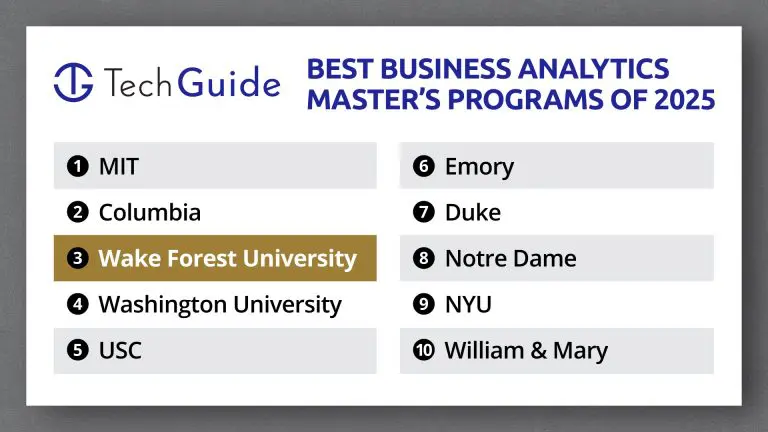
Wake Forest MSBA Program Ranks Among Top 3 by TechGuide
At the Heart of Business
Helping businesses and organizations
create a better world

Business Education at
Wake Forest University
Explore our undergraduate and graduate business programs, where students from widely diverse backgrounds and interests learn to use business to make a difference.

Undergraduate Programs
Nationally-ranked Bachelor of Science degree programs in Accountancy, Business and Enterprise Management, Finance and Decision Analytics.

Master of Business Administration
Offered in Winston-Salem and Charlotte across three program formats, the #1 part-time MBA program in North Carolina is designed specifically for working professionals.

Master of Science in Accounting
Open to any major, kickstart your accounting career with world-class faculty, premier internship opportunities and unmatched CPA pass rate success.

Master of Science in Business Analytics
Explore advanced methodologies for taking data from insight to impact across a range of functions, including finance, marketing, operations and human resources.

Master of Science in Management
A 10-month, STEM certified/OPT eligible program designed specifically for non-business majors and business minors who want to excel in today’s marketplace.

Pathways with Business
Explore how you can amplify any major with our diverse array of business program options.
School of Business Rankings
Our world-class programs are routinely recognized in major national and international rankings.
#1 and Top 20

Top 25

Top 20

#2

#5
#1 CPA Pass Rate

#1 in Big 4 Recruiting

Top 10
#3


Thought Leadership
We create a vibrant culture of inquiry, embracing interdisciplinary and discipline-based research and providing thought leadership to address business and organizational issues and key societal challenges.
Our People Make a Difference
School of Business faculty, staff, alumni, students, and partners each have an important role in helping to make the world a better place.

Optimizing Conservation

Supporting a Pro Humanitate Mission

Analyzing Innovation

Shaping the Future

Giving a Voice to the Voiceless
Featured
Research
Explore a few of the groundbreaking ways our faculty uses research to address business and organizational issues and key societal challenges.
Journal of Medical Internet Research
Journal of Medical Internet Research
Harvard Business Review
Harvard Business Review
Journal of Business Research
Journal of Business Research
Research Policy
Research Policy
Journal of Financial Reporting and Accounting
Journal of Financial Reporting and Accounting
Business & Professional Ethics Journal
Business & Professional Ethics Journal

Our academic centers drive thought leadership and create an unrivaled connection to the market.
At the cutting edge of academic research & impact
Our Community
We are friends to all humanity, teaching, helping, and serving, with friendship and honor.

Supporting NC Families in Need

Paul Griggs (’96, MSA ’97)
PwC US Senior Partner

Ashley Wilcox (Director of Sustainability Initiatives)

Isra Al Hashimi (B.S., Business and Enterprise Management, MSBA)
School of Business News
5 Student Services Online MBA Students Need
(U.S. News & World Report)
Are Gen Z ‘Sellouts’ If They Take Corporate Jobs?
(Fast Company)

Julie Holliday Wayne: Is There a Plus Side to Mental Labor?
(Scientific American)
Upcoming Events
Join the School of Business for a broad assortment of events and happenings that advance the practice of business.
MBA Virtual Information Session
Are you a working professional considering an MBA from the Wake Forest School of Business? Join our virtual session to connect with the Wake Forest Enrollment Management team to explore our MBA programs in Charlotte and Winston-Salem. We’ll cover the admissions process, curriculum, and how a Wake Forest MBA can help you achieve your professional goals while fitting seamlessly into your lifestyle. Register here.
Ethical AI Use
Do you want to know more about Generative AI? Join us for the next session of the Building AI Fluency Learning Series hosted by the Wake Forest School of Business. This series provides a collaborative learning environment aimed at enhancing our understanding of Generative AI and how it can be effectively utilized within your respective teams and departments.
Wake Forest Visits Florida A&M: Fall 2024 Career & Internship Expo
Attention, Attention, all future BizDeacs in the Tallahassee area ! After finishing your undergrad, what are your professional career goals? Have you solidified your plan for Summer/Fall 2025? If not, we have great news for you! The School of Business at Wake Forest will be visiting Florida A&M University, Wednesday, September 25, 2024 for their Fall 2024 Career & Internship Connections Expo! Come grab your chance to connect with WFUSB Assistant Director, Enrollment Management, Janasi Rawlings as she connects, and shares information about our Pre-Experienced, accelerated graduate programs in MS in Accountancy, MS in Business Analytics, and MS in Management! She will also share testimonies of how future Wake Forest business students gain a competitive edge in their career fields in as little as 10-months! We cannot wait to see you there!
Wake Forest University Football vs SMU- Homecoming
Wake Forest University Football vs SMU- Homecoming Tickets: System.Threading.Tasks.Task`1[System.String] https://godeacs.com/calendar.aspx?game_id=14155&sport_id=4
Homecoming and Reunion Weekend
Join thousands of alumni as they return to Mother So Dear for Homecoming and Reunion Weekend 2025. Class years ending in 0s and 5s will hold reunion events.
Homecoming and Reunion Weekend
Join thousands of alumni as they return to Mother So Dear for Homecoming and Reunion Weekend 2025. Class years ending in 0s and 5s will hold reunion events.
School of Business Social Media
Follow our social media channels to stay current on everything happening at the School of Business.


Explore Further
Considering a business program to strengthen your career prospects? Interested in the world-class research being done by our faculty? Or just want to speak with someone to learn more about the School of Business? Here are a few more areas to explore.
