Ali Zeytoon-Nejad
Explaining Economics
Zeytoon-Nejad is fascinated by business economics and managerial economics, focusing his research on concepts such as risk aversion, behavioral economics, insurance modeling, and production functions. He is equally passionate about teaching, empowering students to “make economically rational, efficient and optimal decisions. Our students will serve as business leaders for their companies, so these skills are essential for their success.”

Position
Education
Research Interests
Teaching Interests
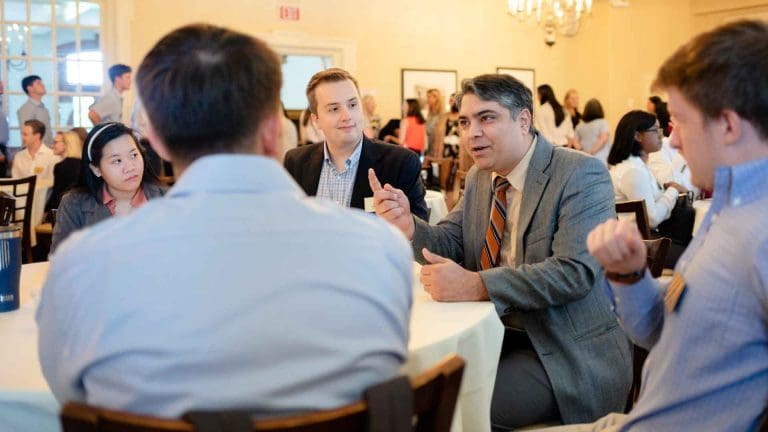
Though Ali Zeytoon-Nejad grew up with an economist father, initially he pursued a totally different field of study: mining engineering. The discipline, which taps into mathematics, physics, chemistry, and geology, allowed Zeytoon-Nejad to learn how to find the most technically viable options in mine extraction, assessing the overall feasibility of mining projects.
As he explored the technical viability of mining methods, Zeytoon-Nejad also began learning about the economic considerations of mining projects.
“I took a course called engineering economics and learned that I’m very interested in economics,” he realized. “In that course, we looked at all the technically feasible options and determined which of them were economically viable or justifiable. The idea of rational decision-making, such as cost-benefit analysis, is what drew me to economics.”
That realization drove Zeytoon-Nejad to pursue economics in his post-graduate work. Initially, he planned to be an economist upon completing his PhD in the discipline at North Carolina State University, but a love of teaching he discovered tutoring a high-school classmate led him to academia instead.
“As I did research in economics while earning my graduate degrees, I began to realize that research and teaching were two of my passions. That was the turning point for me to decide to stay in academia.”
Research and teaching continue to be passions for Zeytoon-Nejad, and he says Wake Forest has allowed him to pursue both with its teacher-scholar model. On the research front, Zeytoon-Nejad focuses on business economics and managerial economics, examining concepts such as risk aversion, behavioral economics, insurance modeling, and production functions.
Zeytoon-Nejad also serves as a research affiliate for the Center for the Study of Capitalism at Wake Forest University. “In that role, I have an active line of research in the area of economic systems and comparative economics, which studies and compares economic performance across different economic systems.”
That research translates directly to the classroom through practical knowledge and skills that students can apply to the workplace once they graduate and move into their careers.
“As an economist working in a school of business, my first job is to bring economic tools to my students so that they can apply them immediately in their workplace to make economically rational, efficient and optimal decisions. Our students will serve as business leaders for their companies, so these skills are essential for their success.”
Zeytoon-Nejad also co-teaches an undergraduate course with School of Business colleague Rob Nash, entitled Foundations of Capitalism. He says that class allows him to give a wider range of students a deep dive into the capitalist economy of the United States and how it fits into the greater global economy.
“My role in that course is to train students on the U.S. economic system, laissez-faire capitalism, the market economy and the free-enterprise system,” he notes. “We explain the foundations of the market system so that our students can develop a comprehensive, big-picture understanding of how the economic system of the U.S. functions.”
This class and the partnership he has with Nash illustrates one of the greatest benefits of being part of the faculty at Wake Forest—the vast network of expertise on campus.
“Wake Forest University, and the School of Business in particular, is truly a community of great minds. Working and living alongside every single member of this community has been a great pleasure and an absolute honor of my life.”
Zeytoon-Nejad believes the School of Business doesn’t just equip its students with the technical and intellectual tools to be successful in their careers—it also teaches them the role businesses play in society and how they can be a catalyst for good.
“We are an institution that stands by truth and also sympathy to ensure we get things right and also do good,. We believe business education is one of the most effective ways to serve society. A major strength of business as a social servant and a force for good lies in the fact that business is essentially built upon free will, incentive compatibility, voluntary exchange, and mutual benefits, when all are pursued within ethical confines.”
“The motto of Wake Forest University, Pro Humanitate, inspires us to use our skills to serve the community through mutually beneficial trades, value-generating markets, and ethical business practices. This is what we are passionate about at the School of Business.”
Recent Research

Ali Zeytoon-Nejad
Iglehart-Lightcap Faculty Fellow; Associate Teaching Professor

Explore Further
Considering a business program to strengthen your career prospects? Interested in the world-class research being done by our faculty? Or just want to speak with someone to learn more about the School of Business? Here are a few more areas to explore.
