Greg Stewart
Enabling Teamwork
As senior associate dean for faculty and research, Greg Stewart’s goals include “building a culture of excellence that allows people to be engaged and motivated in doing work that aligns with their values, taking away any barriers to doing that, and rewarding faculty for doing outstanding work.”

Position
Education
Research Interests
Teaching Interests
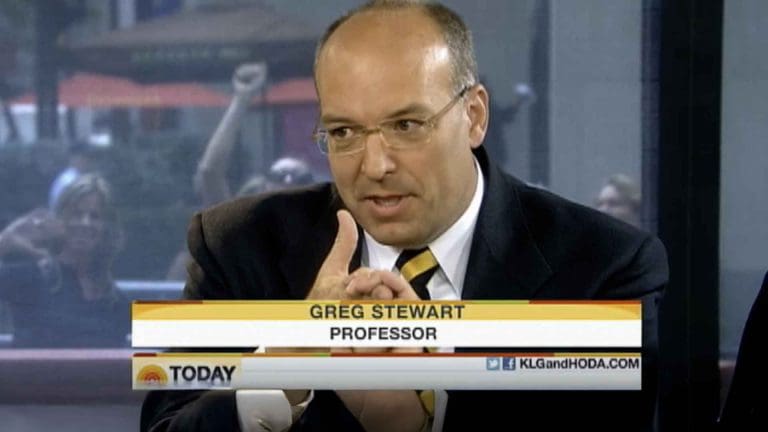
As senior associate dean for faculty and research, Greg Stewart’s goals include “building a culture of excellence that allows people to be engaged and motivated in doing work that aligns with their values, taking away any barriers to doing that, and rewarding faculty for doing outstanding work.”
The winner of numerous teaching awards, a sought-after consultant and trainer, and author of the textbook “Human Resource Management: Linking Strategy to Practice,” Stewart joined the School of Business as the Thomas K. Hearn, Jr. Professor in 2025. In his administrative role, he oversees hiring, developing, mentoring and evaluating faculty. He also seeks to create opportunities for them to engage in research that contributes to the overall goals of the School.
The role fits neatly with Stewart’s own long research career. “In many ways, my research is about human resources, and this role is human resources,” explains Stewart, who is recognized as among the top 2% most impactful lifetime scholars in the field of management, according to a Stanford University study.
Stewart’s work has been published in leading management journals including Journal of Applied Psychology, Personnel Psychology, Academy of Management Journal, Organization Science, Journal of Management, and Organizational Dynamics, as well as in health care journals such as the Journal of Nursing Administration, Journal of Nursing Care Quality, Journal of General Internal Medicine, American Journal of Managed Care, and Healthcare. He served as an associate editor for Journal of Management.
His early research, mostly done in manufacturing settings, focused on correlations between personality traits and job performance, and then evolved to look at combinations of personality traits among team members. He later transitioned to focus on leadership and teams in the health care sector, particularly within Veterans Affairs.
He’s particularly interested in making teams more effective by designing them from the ground up, rather than trying to solve problems once teams have formed.
“Part of that is getting the right team leader, but it’s also questions of, who should be on the team? How should tasks get divided up on the team? How should people in different roles coordinate with each other?”
One current project is studying multiple team membership. “We’ve looked particularly at primary care teams,” Stewart notes. “Should a nurse be assigned to the same doctor on one team all the time or would a nurse be better deployed to three different teams led by three different doctors? The answer to that question is pretty clear: You’re better off when you can focus on one team or at least fewer teams.” That’s because limited team membership helps improve focus and allows team members to develop stronger relationships with colleagues.
One of his most impactful pieces of research examined the traits of effective leaders, discovering that what held true in other organizations also holds true in health care settings: Effective leaders empower other people to use their talents and skills. But, because of both training and temperament, physicians aren’t always predisposed to empowering others, he notes. Through the research, published in the Academy of Management Journal, “we were able to come up with some very specific ways that could help physicians empower people and then we came up with training to help them do that.”
It’s important to Stewart that his research has real-world impacts, and the starting place for his inquiries is often a problem he observes while working with an organization.
“I call it abductive research. The idea is you see a problem and step back and think, what theories do we know that might help solve this problem? What data do we need to help us understand the problem? Then we design a strategy and go test it.”
“It doesn’t do me any good to develop a grand theory that no one will ever use to make things better — and my goal is to make the world better,” he adds.
“One thing that drives me is the idea of Pro Humanitate. The idea that we’re trying to make a difference in society and trying to make the lives of others better resonates strongly with me.”
Recent Research

Greg Stewart
Senior Associate Dean for Faculty & Research; Department Chair for Management; Thomas K. Hearn, Jr. Professor; Professor

Explore Further
Considering a business program to strengthen your career prospects? Interested in the world-class research being done by our faculty? Or just want to speak with someone to learn more about the School of Business? Here are a few more areas to explore.
