Michelle Steward
Deciphering Ambiguity
Drawing on the behavioral insights of her background in cultural anthropology, Michelle Steward seeks to better understand how business decisions get made. Her research focuses on “how the decisions people make are shaped by their values and beliefs across contexts,. And I’ve always been absolutely fascinated by how those decisions play out in the marketplace.”

Position
Education
- Ph D, Arizona State University (Marketing) – 2004
- MBA, University of West Florida- 1993
- BA, University of West Florida (Cultural Anthropology) – 1991
Research Interests
- Customer feedback
- Customer surveys
- Superior firm performance
Teaching Interests
- I teach in both our undergraduate program and our Master of Science in Management (MSM) program. In addition, I am a Faculty Affiliate of our Center for the Study of Capitalism which helps our students better understand the market economy.
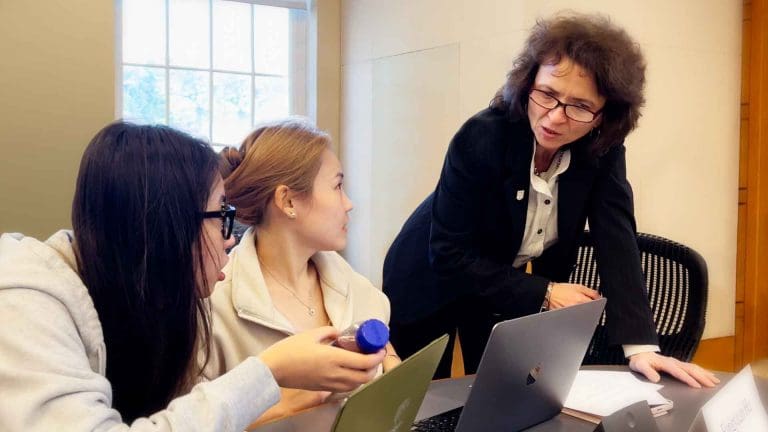
As an undergrad at the University of West Florida, Michelle Steward studied cultural anthropology, a discipline that examines the connections and variations of human cultures. That background, she says, still informs her work in marketing today.
“I was most interested in how the decisions people make are shaped by their values and beliefs across contexts,. And I’ve always been absolutely fascinated by how those decisions play out in the marketplace.”
Steward melded those two worlds in her post-graduate studies in marketing—as well as during a stint working for the Ministry of Education in South Korea—applying the behavioral insight of cultural anthropology to better understand how business decisions get made.
“My MBA and my PhD gave me the formal tools to understand those kinds of dynamics in a more systematic way. If you look at the variety of projects over my career on the surface, some of them appear to be quite different from one another. But I think they all illustrate that businesses do not solve their problems unless they solve enough customer problems.”
Steward draws on that background in her research, focusing on how marketing impacts performance for businesses. The notion of how businesses can better solve customer problems remains at the heart of her work.
For instance, a recent research project Steward conducted in partnership with colleagues at Tulane University and the University of Miami looks at why customers withhold honest feedback from companies when those businesses directly
ask for opinions.
“We found that customers sugercoat their feedback, while at the same time, businesses think consumers are actually quite frank. The reality is that mismatch of customer sugarcoating and businesses believing that we’re very blunt about our feedback can cause a gross misallocation of resources. It can lead a company to solve the wrong problems.”
As a result of their research, Steward and her team developed a technique to deactivate this effect and uncover more valuable insights from customers to prevent misallocating resources. She believes it’s important to share this research beyond the academic arena so that businesses can actually benefit from their findings.
“To me, there’s a very valuable two-way bridge that we have to have in higher education where we’re offering value, and we’re also addressing real, pressing problems that businesses have.”
Steward also translates that research to the classroom. Teaching both undergraduates and graduate students, as well as in her role as Faculty Affiliate for the Center for the Study of Capitalism, Steward emphasizes the power and nuance of decision-making.
“My mission for my students is to help them build what I call a confident competence to begin to work on solutions. I work to create opportunities for my students to build a mindset around marketing as a problem-solving approach with real consequences.”
Steward presents case studies of real businesses, as well as simulations that allow students to exercise the practice of making business decisions rooted in an understanding of human behavior.
“They get to think critically about data, but they also have to anticipate the human side of decisions,” she points out. “They see how the human side of decisions presents uncertainty and ambiguity just like they will face in their workplaces.”
That idea of accounting for the variables of human decisions also presents an opportunity for students to be more creative in problem-solving as they navigate their careers. Steward believes the academic setting allows them to practice that skill in a low-risk way.
“There’s a real genuine curiosity in people, and if we rekindle that in all of us, and in my students in particular, I think it will help them provide more meaningful solutions for their companies in the future. It’s all about curiosity and helping them think critically in situations that have a lot of ambiguity, and higher ed is a wonderful arena for them to do that.”
Steward has been at Wake Forest for more than two decades, and she says the University and the School of Business in particular foster an environment that can promote this type of exploration and experimentation for both faculty and students.
“For me, part of living Pro Humanitate requires experimenting with a lot of different approaches, both in my research and my teaching. I’ve been very fortunate at Wake to be strongly encouraged to experiment, to recognize that not all experiments are going to come off exactly as we hope, but there will be lots of lessons learned.”
Recent Research
Journal of General Management
Journal of General Management
Vikalpa
Vikalpa
Journal of Public Policy & Marketing
Journal of Public Policy & Marketing

Dr. Michelle Steward
Hendley-Lightcap Faculty Fellow in Free Enterprise & Entrepreneurship; Associate Professor

Explore Further
Considering a business program to strengthen your career prospects? Interested in the world-class research being done by our faculty? Or just want to speak with someone to learn more about the School of Business? Here are a few more areas to explore.
