Wake Forest School of Business Receives AACSB Global Impact Award for Use of AI in Teaching and Learning
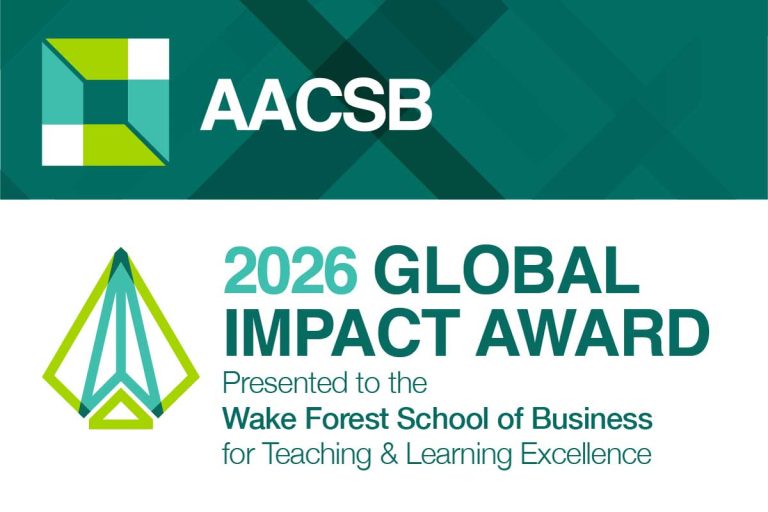
Wake Forest School of Business has been recognized as a winner of AACSB International’s inaugural Global Impact Awards for the School’s creative and effective use of generative artificial intelligence in teaching and learning.
The Global Impact Awards honor individuals and institutions whose initiatives exemplify innovation, leadership, and measurable impact in business education and society. Grounded in AACSB’s Global Standards for Business Education™, the awards highlight contributions from across the global business education community.
Wake Forest School of Business was recognized in the category of Teaching and Learning Excellence for its “Building AI Fluency” initiative, a multiphase program that accelerated the responsible integration of generative AI into faculty workflows and student curricula.
“We are grateful to AACSB for this recognition, which celebrates the collaborative spirit within our school and affirms our strategic commitment to embracing emerging and future technologies. The ‘Building AI Fluency’ initiative turned the uncertainty of new technology into a shared learning experience for our faculty and staff. This honor serves as evidence of our commitment to provide high-impact learning experiences that prepare our students for a competitive, global market,” said Stacie Petter, Acting Dean of the School of Business.
The “Building AI Fluency” initiative was designed to meet the immediate urgency created by the release of ChatGPT in late 2022. The grassroots program moved from initial exploration to structured learning opportunities and classroom application.
“We’ve learned that AI fluency isn’t really a technical skill; it’s a judgment skill. We want graduates who know when to use AI, when to push back, and when not to use it. Employers are desperate for that kind of discernment, and it has to be built in the classroom, not assumed at graduation,” said Shannon McKeen, Executive Director of Experiential Learning & Innovation and Professor of the Practice. McKeen spearheaded the initiative alongside John Montana, an Executive Director who supported the School’s AI efforts as part of its strategic initiatives group.
The impact of the initiative is measurable. A reported 68 percent of business faculty now use generative AI on a weekly or daily basis, more than double the national average of approximately 30 percent for higher education faculty. These efforts have resulted in classroom innovations, including the use of custom GPTs for business simulations and AI-enhanced feedback mechanisms. Faculty are also utilizing pedagogical tools to generate practice problems and provide students with additional tutoring support.
The 2026 Global Impact Awards honorees include 27 individuals and institutions from 16 countries, selected from a highly competitive pool of submissions. Award recipients are recognized for shaping future-ready business schools through strategic leadership, translating faculty research into meaningful impact, fostering inclusive social and economic growth, integrating emerging technologies into learning experiences, and supporting the AACSB community through dedicated service.
“The Global Impact Awards underscore Wake Forest University’s commitment to creating meaningful impact through business education,” said Lily Bi, president and CEO of AACSB.” Their work sets a powerful example for the future of business education, and we look forward to its continued growth and influence.”
Winners will be formally recognized at AACSB’s International Conference and Meetings in Seattle, Washington, April 13–15.
For more information about the AACSB Global Impact Awards and details on this year’s winners, visit www.aacsb.edu/global-impact-awards. Support for the 2026 Global Impact Awards is provided by Risepoint.
