Alumna’s Journey to the Center of Pro Sports
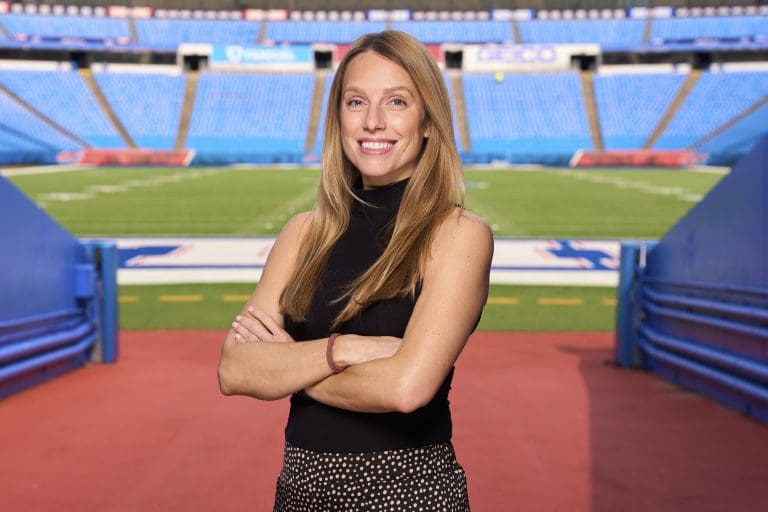
Kate Hussmann (MBA ’17), Chief Strategy Officer, Buffalo Bills
You’ve built an impressive career in sports business, from the NBA to Major League Baseball to the Buffalo Bills. What drew you to pursue a career in athletics strategy and operations?
My path into sports was a bit of an accident. I initially studied business and chemistry, and even went to culinary school, but I found my “dream job” wasn’t what I expected. I decided to pivot and look at consumer-facing industries undergoing significant change, like fintech, healthcare, and sports. I cold-emailed a woman that I hadn’t seen since I was 15 who was newly employed at the [Charlotte] Hornets and was building her team. She kindly agreed to have breakfast with me and I continued to email her regularly until she hired me.
When I first started, it was an interesting time in the sports industry. Strategy departments and mobile ticketing didn’t exist, and we were just beginning to use customer data to drive the business. I just happened to be at the NBA when they were really investing in these areas, so I raised my hand to participate and take on whatever I could.
As Chief Strategy Officer for the Bills, what does a “day in the life” look like for you?
No two days are the same, which is my favorite part of the job. I could be working on how to maximize revenue in our new stadium, growing our fan base in Southern Ontario, or building a cutting-edge analytics team. My work focuses on longer-term initiatives, which in theory but not always in practice, allows me to avoid getting caught in the day-to-day routine and instead focus on the future.
When I started in sports, we were still printing tickets – we had no idea who was in our stadiums or in our arenas. QR codes and mobile wallets didn’t exist. The media ecosystem was completely different. Streaming was just beginning at that time. The past decade has really been a fascinating time to be in the sports industry, and it continues to evolve and change. People will always love live sports. It’s an irreplaceable product that’s somewhat recession-proof and AI-proof. However, technology and analytics are influencing how people consume live sports, so how we reach and communicate with our fans will need to keep evolving.
What has been the most exciting or rewarding project you’ve worked on since joining the Bills?
Our efforts in Southern Ontario have been really exciting. There’s this perception of the Bills as one of the smallest markets in professional sports, but the Bills are a national and international brand. There’s truly nothing like the Bills Mafia! I’m not from Buffalo, and experiencing it as an outsider has been really magical. It’s like college football meets the EPL (English Premier League). It’s this incredibly dedicated fan base, and that fandom extends north of the border into the third largest city in North America, Toronto. Helping grow brand awareness to ensure that brands, not just our fans, but national and international brands are aware of the Bills’ presence and Bills’ fandom in Southern Ontario is really rewarding.
The new stadium project has also been incredible. To see the effort, planning, thought and detail that went into designing a stadium built for this market and incredible fan base come to fruition has been amazing. My office window overlooks the construction, and I marvel at the thousands of hours people have worked in incredibly difficult conditions to make the stadium come to life.
What skills or qualities do you think are most essential for leadership in the sports industry today?
Initiative is huge – you have to be extremely proactive and raise your hand! Sports moves at a breakneck speed. I’ve worked across three leagues now, and it’s really easy for teams to get caught up in the idea of “let’s just get through this season”. If you want to focus on longer-term strategic or analytical initiatives, you’ve got to raise your hand, own it, and push those things forward.
Persistence and a strong work ethic are truly crucial in the sports industry. While many perceive the field as glamorous, picturing constant schmoozing with athletes and attending games, the reality is it’s a grind. Our teams often work until 2:00 a.m., especially during prime-time games. I’ve seen teammates at the stadium until midnight every single night, with someone sitting on a bucket in the back of a concession stand making sure that the latest mobile wallet technology works. This level of dedication and persistence is absolutely vital—a truth that applies to many professions but is often overlooked in sports due to its perceived glamour. You can’t go into it with the expectation that you’ll be sitting in a suite watching a game every weekend!
How did your Wake Forest MBA prepare you for your current role and the challenges of the sports business world?
While working at the Hornets, I enrolled in the MBA program, which I found tremendously valuable. I had a foundation in business from my undergraduate program, but as a student taking classes and not working in business at the time, it can be a nebulous concept. If you’re taking classes in real time while working, there’s always something that has direct application.
I was managing the All-Star project when we brought the NBA All-Star Game to Charlotte in 2019, which was a very challenging time due to controversy around the bathroom bill. I was completing my MBA at that time. In fact, I used what I learned in my organizational behavior classes to provide a framework as I was navigating sticky conversations with the North Carolina government, the NBA office in New York, and how we wanted to approach it as a team. To me, it was helpful to be in a learning environment and then immediately go to work, and there was a direct tie.
What excites you most about the future of the Bills and the sports industry more broadly?
I feel incredibly lucky to have joined the Bills at such a great time. We have great leadership, a perennial Super Bowl contending team, and an amazing quarterback. But most importantly, we have a new stadium opening in 2026, a massive marketing area to explore, and the best fan base in sports. I’m so excited to see the stadium open and for Bills Mafia to experience it.
The sports industry continues to evolve. I think analytics will continue to drive and shape the business in a way that it hasn’t historically, particularly now with the barriers to entry for analyzing large data sets becoming lower. I believe it will further democratize data and allow for more data-driven decision-making. And, we will continue to see demand for a live event experience grow, which is exciting to be a part of. Not all industries can say the same, so I’m grateful to be a part of it. I feel very lucky!
Spotlight interview conducted by Alumni Council member Molly Rutledge (‘04, MSBA ‘20).
