A 20-Year Sprint: Leading with Purpose & Sole

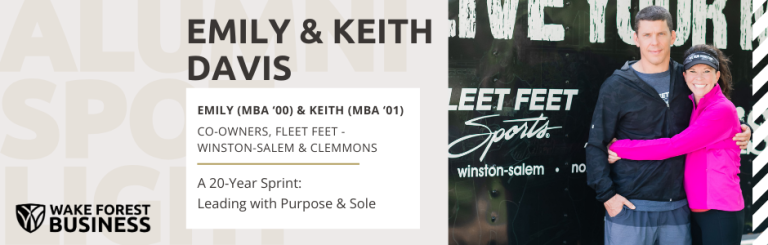
Emily (MBA ’00) & Keith Davis (MBA ‘01), Co-owners, Fleet Feet – Winston-Salem & Clemmons
You both had successful trajectories in marketing and finance. What was the specific “lightbulb moment” or conversation that led you to trade the corporate ladder for the uncertainty of entrepreneurship?
Emily: I grew up in New Jersey, graduated from Rutgers and then moved to Winston-Salem to start the MBA program. I was a second-year student when Keith was a first-year – I still remember what he was wearing the day I met him! After graduation, I stayed local to work at Hanes and then took a fantastic opportunity in marketing with Gallo Winery in California. Keith ended up moving west, too, and got a job in Gallo’s logistics. I loved it out there; he hated it! Coincidentally, we actually discovered Fleet Feet when we were in California. We had both signed up for a triathlon;Keith forgot to bring his wetsuit,so we stopped by the local Fleet Feet in Sacramento where he could rent one. Keith struck up a conversation with the [now former] owner, who we later learned was a legendary Fleet Feet owner. The fire was lit for Keith! Once we got engaged, we decided to move back to North Carolina with the plan of opening a store.
While Keith is trying to learn retail making $7.50 an hour at the Carrboro Fleet Feet store, I’m over here thinking “we have two graduate degrees between us and this is a dead end!” After getting married, we both realize the store is a failed plan.Keith goes to work at BB&T and I return to Hanes. We did the corporate thing for two more years, and we were happy enough. One night we’re eating dinner in our house in Ardmore and look at each other thinking, “is this really what we want for our future family and life?” There had to be something more. From there, we decided to start the conversation (again) with Fleet Feet corporate to start a store. And that’s how the whole thing started!
Keith: We were at that point where we had done all the things that we thought we were supposed to do, but climbing the corporate ladder was not going where we wanted to go. I came from a family of small business entrepreneurs. I knew I would love to own or run my own company one day; I just had no idea what that was. When we connected with Fleet Feet, it was this perfect intersection of all of our passions, and the first time that I knew this would not just be a hobby or a passion, but a lifestyle and a profession.
When it was time to open the store, we knew that it wasn’t going to create enough cash flow to support our growing family. Emily continued to work and I dedicated myself to opening the business. Fortunately, everything worked out and the business became successful, but it was not without compromise. I certainly never dreamed it would become what it is now as we enter our 20th anniversary with Fleet Feet.
How do you two combine Keith’s finance background and Emily’s marketing skillset to create a cohesive vision and working relationship for the store?
Emily: You can’t have two people running a business with the final say, especially as you’re trying to grow it. You’re learning as you go and you make a lot of decisions on the fly. We quickly learned that there’s no handbook that maps out exactly how to run a business. Every business and every market is different. I really struggled with taking the second seat and letting Keith have final say. It took a long time to define clear boundaries and dividing lines of what I was going to do vs. what he was going to do. With my background in marketing, branding and PR and his in finance and inventory management, it worked well together.
We had to learn each other’s work personalities, and it was not always easy! But, you have to choose what’s most important. I had to get to a place where I was ok even though Keith made a decision that was different than what I would do – I had to trust that he was leading us to the right place.
Keith: Emily was pregnant in the first year of our business, and then we had our second daughter two years later. And then we took a long break and had our third daughter in 2015. So for us, it’s truly a family business. Entrepreneurship sounds really cool when you talk about it in your business school class, but you realize a family business and entrepreneurialism are two different things. Neither one of us would change anything, but we certainly wouldn’t have chosen the path had we known all of the ups and downs along the way without knowing the payoff.
Owning a family business has created a more meaningful life for your three daughters. How has involving them in the family business and your mission work shaped their worldview?
Keith: Emily has had to defer to me on a lot of business issues and I’ve had to defer to her on a lot of family issues. We have debates at the kitchen table, oftentimes in front of our kids, and sometimes we feel guilty about that. It’s taken our kids a long time to really care about being part of the business, but now they finally are. The two oldest have worked in the business after years of saying they never would. I’m training my oldest daughter for her first marathon. Ultimately, all these things that we thought were a train wreck years ago were learning opportunities – they got a front row seat to watching the ways we solved problems in real time. It’s helped our children grow to become very mature and capable.
Emily: I had somebody tell me once that your kids need to see that a husband and wife can disagree and that they figure it out; ours have seen plenty of that! Seriously though, they need to see that marriage is a lot of give and take. As far as worldview, we didn’t go into the business with this plan, but our business has become a ministry first. We do homeless shoe fittings; we all go [as a family] to Kenya every year and bring shoes with us – our kids are a part of all of it. We’ve tried to teach them that wherever you are, you can be in ministry. You can use your gifts and talents to serve others, whatever you do. And so that has become our biggest objective. As we’re raising our three kids, we want them to determine how they can use their role, wherever they are, to contribute to this world. It’s exciting to watch them as they figure that out on their own.
Out of 280 Fleet Feet stores, you are consistently in the top tier. How do you maintain a high-performance business culture while dedicating so much time to non-profit work?
Emily: They go together. Keith has worked hard to develop a higher-level team that can manage the day-to-day. We’re preparing for how we transition this business to someone else, and it’s not just run by Emily and Keith. You can’t only serve without the business side; and we don’t feel like it’s right to just do business without serving. For us, they absolutely go together.
Keith: This question takes me back to a talk I heard years ago by Kelly King [former COO] when I was working at BB&T. He explained that on one hand, you have pure altruism, and he described how altruism was ultimately a self-defeating kind of mindset. And then on the other hand, you have pure capitalism, which is just cutthroat business. He said the balance is in the company that runs the business responsibly and in the right way – they’re mutually beneficial. It’s all about balance. Sometimes the pendulum has to swing a little bit more one way or the other, but ultimately, this is the basic principle for success. For me, that is the formula that has consistently worked for us.
Through the Good Works Engine, you provide over 3,000 pairs of shoes annually to marginalized populations. Why was it important for you to serve the “tent city” and prison-release communities specifically?
Emily: It all started small with one-off requests. Then, one of our first large opportunities was to fit kids participating in a Special Olympics. We ended up forming the nonprofit because we were getting more and more requests! Now it’s been 16 years of donated shoes, and we’ve been able to connect with the homeless community, tent city community and kids in low-income elementary schools that don’t have proper fitting shoes. With our prison ministry, newly released prisoners come to Fleet Feet and get a fresh pair of shoes. Some of them want to leave their old shoes behind to have an official breakup with prison and moving-on point. Many customers specifically shop with us (and not on Amazon or online) because they’re aware of what we do in the community and they want to thank us.
Using donated funds to bless other people has been our favorite role. We organize an annual 5K at the prison for the inmates, and people want to be there because they want to be part of what we’re doing. When we go to Kenya to serve with a running academy and village ministry, people often say, “I want to go to Kenya with you the next time you go”. If we are the gate through which others are introduced to serve the community, then that’s who we should be. It’s rewarding to have people in the community raising their hands saying, “I saw what you did, and I want to be part of that next time”.
Have you found that the WFU network has played a role in your business’ success and/or your philanthropic efforts?
Emily: One of the reasons that we didn’t open our own store in California was because we were going to be on an island! Our network here in North Carolina means everything. Thinking back to those first couple years, it was the Wake Forest community that got behind us and that helped give us the early momentum to build from there.
Keith: It just opened so many doors and continues to do so. I’m a Winston-Salem boy, so there’s a “this is where I grew up” feeling; Wake Forest goes hand-in-hand in all our local circles.
What is one piece of advice you’d give to a current MBA (do we need to specify?) student who has an “entrepreneurial itch” but is afraid of the risk?
Emily: A lot of people laughed at us when we said we wanted to open a business. Keith had people in the running world community tell him, “You won’t be open in a year”. I had family members laughing at us, and my great aunt even wrote us a note and said, “good luck being a shoe store manager.” But I never doubted that we would give it everything we had. We weren’t prepared for [the business] constantly evolving – improvements, processes, products – all of it is constant. You must evolve or you’re irrelevant.
I would tell an MBA student to just tune out the people saying that you can’t do it – even if it’s family. If you have the education, the drive, and the passion, you will do it. There’s this quote that Keith recently shared, “You have to be uncommon”. It’s true; you have to be uncommon in your drive to keep going after it every single day. For us, it’s been 20 years. I’m proud of the impact we’ve had on our community.
Spotlight interview conducted by Alumni Council member Greg Baker (MSA ‘13).
