Solving Problems By Putting People First

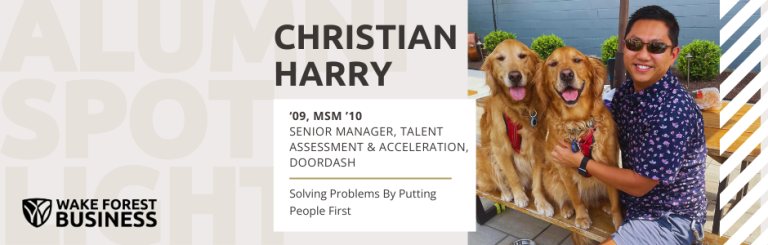
Christian Harry (‘09, MSM ‘10), Senior Manager, Talent Assessment & Acceleration, DoorDash
As a Senior Manager of Talent Assessment & Acceleration, how do you define “success” for the people you are helping to grow?
In my role, I operate at the intersection of business and people management. My success hinges on the ability to provide the tools, mechanisms and data that empower employees to grow and reach their full potential while still executing business strategy and delivering results. Ultimately, when we can positively influence people’s lives – whether that be financially, professionally or even personally – I consider that a significant success.
You spent significant time at Deloitte, moving from Senior Consultant to Manager. What is the most important “consulting mindset” habit you still use today at DoorDash?
I spent several years consulting, and it taught me a lot. I enjoyed many aspects of that experience but there are three key lessons I learned that are important in my current role.
- Understanding the Problem: Before you build anything, you have to be clear on what’s actually broken and why. Consulting drilled home the importance of root-cause thinking. It taught me not to just react to whatever is visible or loud, but to fix the actual source of the issue. That mindset still shows up in how I approach programs and initiatives today; I know to slow down just enough to confirm we’re aiming at the real issue.
- Leading with Data: It’s not enough to have a strong point of view – you need to show why it’s the right one and what it changes. Data is how you make your recommendation credible, compare options and demonstrate outcomes. It also travels well across audiences, from close partners to execs, because it turns “I think” into “here’s what we know.”
- Building Relationships: Consulting is a relationship business, and that doesn’t magically stop once you’re in the industry sector. Building trust makes the work more enjoyable, but it also makes it faster – things move when people know you, respect you and believe you’ll handle situations well. The simplest – and most underrated – part is to treat everyone with respect, regardless of their role. Work is still humans trying to do hard things together.
You have worked for some of the most recognizable “blue chip” brands in the world (Aon, Deloitte, Apple, DoorDash). How has seeing the internal cultures of these different giants shaped your philosophy on what makes a “top talent” employee?
Throughout my experiences, I have learned several important lessons. First, there are many ways to solve the same problem. In consulting we often leaned on subject-matter expertise, but I quickly learned that diverse perspectives and alternative approaches often lead to better, more creative solutions, especially when teams pause to surface different options rather than defaulting to the familiar.
Second, people bring different strengths, and the best teams let those strengths show up. It’s tempting to assume one “right” way based on past success, but flexibility and openness to other methods unlock better outcomes and make people feel valued at the table.
Third, careers aren’t linear. Some of the highest-performing people I’ve worked with came from nontraditional backgrounds; their varied experiences often translate into unexpected advantages. When I evaluate talent, I look for the underlying skills and capabilities that drive impact rather than a single career script.
Finally, everything ties back to understanding the business and where the real levers for growth are. The capabilities you need will evolve over time, so the right approach is to stay curious, stay flexible and build teams that can adapt as the strategy changes.
Looking back at your time in the MSM program, which specific skill or class ended up being the “secret weapon” for your early career success?
Dr. Jon Pinder’s Business Analytics class was the one that taught me to truly understand data and use Excel in a way that’s useful and not just functional. That skill set has guided me through every role, allowing me to pull insights out of messy information and translate them into something other people can act on. An analytical mindset plus an Excel fluency has helped me differentiate myself throughout my career, especially in consulting and tech where credibility tends to start with the numbers.
If you could go back to 2010 and give “Student Christian” one piece of advice, what would it be?
Be flexible. You don’t have to have it all figured out immediately! Early on at both Wake Forest and Duke, there was a lot of pressure to land the perfect job at the perfect company right out of the gate. But the reality is people change roles, teams, and companies quickly – often within two or three years. So you can stress yourself out chasing a very specific company or role, only to realize you were always going to evolve past it anyway.
My advice is to be open to the diverse experiences you’ll encounter and the lessons you can learn in each role. Careers are rarely linear. The more open you are to learning and taking smart chances, the better you’ll do over the long run. Embracing flexibility will serve you well on this journey.
You’ve served on the MSM Market Insights Board for four years and currently serve as the Board Chair. What motivates you to stay so deeply involved with the School of Business?
Wake Forest has opened a lot of doors for me, and staying involved feels like a meaningful way to give back – especially to MSM students who are navigating the same questions I was. I also genuinely care about the program’s long-term success. The School helped me build perspective early and now, 15+ years later, it’s motivating to support others as they’re building their own paths.
Beyond work, you and your wife foster dogs through the Neuse River Golden Retriever Rescue. How does that experience help you find balance outside of your corporate role?
We’ve wanted to do this for years, but we didn’t have the right setup until we moved to Raleigh. Between living in Atlanta and the travel-heavy years, it just wasn’t realistic. Now that we’re settled and I work from home, we can actually do it.
This work is incredibly grounding; it reminds us that work isn’t everything. There are so many dogs that need homes, and we feel lucky to be part of their story. We adopted two goldens through a rescue years ago, so fostering feels like paying that forward. It forces you out of “productivity mode” and back into real life.
Has fostering dogs taught you anything about patience or adaptability that you’ve been able to apply to your work in talent development?
Fostering is 100% a journey. Sometimes you think you found the perfect fit, and then it doesn’t work out – and you have to adjust. It’s taught me to make the best decision I can with the information I have, and then give myself grace when the outcome isn’t what I hoped.
It’s also a constant reminder that every dog – and every person – shows up with a backstory you may not fully understand. You don’t always know what someone has been through or what shaped how they operate today. That perspective matters in talent work. Leading with compassion, treating people with respect and finding common ground aren’t “soft skills” – they’re how you build trust and move work forward.
Spotlight interview conducted by Alumni Council member Greg Easley (MBA ’08).
