
Curriculum
Master of Science in Business Analytics
STEM Certified – OPT Extension Eligible Curriculum Embedded with Applied AI NEW: Sports Analytics Concentration 92% Employment (Class of 2025)
Master of Science in Business Analytics Curriculum
The Wake Forest University School of Business’ Master of Science in Business Analytics (MSBA) curriculum is relevant for today’s workforce, crafted with input from corporate partners to meet industry demands. Yet, because Big Data and the skills needed to draw insights from it continue to evolve, our MSBA curriculum also looks toward the future. Course content and projects shed light on the field’s real-world applications, illustrating where the technical knowledge gained intersects with business acumen. Our graduates then become key professionals for identifying patterns, predicting trends, and shaping business decisions, no matter the industry where they secure a position.
The MBA Advantage
As an additional benefit of the Masters in Business Analytics program, Wake Forest MSBA graduates have a head start with the potential to complete their Wake Forest MBA degree in as few as 12 months as part of the MBA Advantage. Graduates will receive credit for program courses that are substantially equivalent to Wake Forest MBA coursework when they return. Typically, candidates return to complete their MBA degree within five years of graduating from the Masters in Business Analytics program.
Goals of the MSBA Curriculum
The Wake Forest School of Business grounds our on-campus MSBA curriculum in applied statistics, management science, and business domain knowledge. We then weave in team-based projects throughout to amplify and identify real world–based applications for the concepts taught in the classroom. Big picture, the 10-month MSBA program trains students on the full spectrum of analytics methodologies and highlights all the ways organizations currently apply data-driven applications. Throughout this intensive, immersive curriculum, you’ll:


Acquire essential programming skills, including Python, Tableau, and SQL

Learn to apply analytics across key business disciplines, including finance, marketing, and operations

Be able to supplement your coursework with presentations from visiting speakers and thought leaders

Hone advanced quantitative capabilities and technical skills, and discover all the areas where they intersect with traditional business concepts

Understand responsible and ethical data usage practices

Utilize the Center for Analytics Impact (CAI) in the classroom and for team-based projects to analyze large datasets, master data mining and predictive modeling, and formulate actionable insights using real-time information from our corporate partners

Leave with a marketable skill that’s essential for extracting insights, streamlining organizational efficiency, identifying new product lines, improving customer service, driving innovation, and making better business decisions
Curriculum at a Glance
Anyone interested in this program needs to have earned an undergraduate degree prior to enrollment and have a solid background in calculus and statistics. Additionally, programming skills aren’t just an asset-they’re essential for the MSBA curriculum’s more technical courses.
In total, the MSBA curriculum extends over three semesters and requires 37.5 credit hours. All students begin in the summer semester and graduate by May of the following year.
Summer Semester
The accelerated summer semester covers all foundational coursework needed to succeed within the Master of Science in Business Analytics program and encourages all students to start exploring related career interests and pathways. All participants need to display mastery of the foundational subjects before proceeding on to the rest of the curriculum.
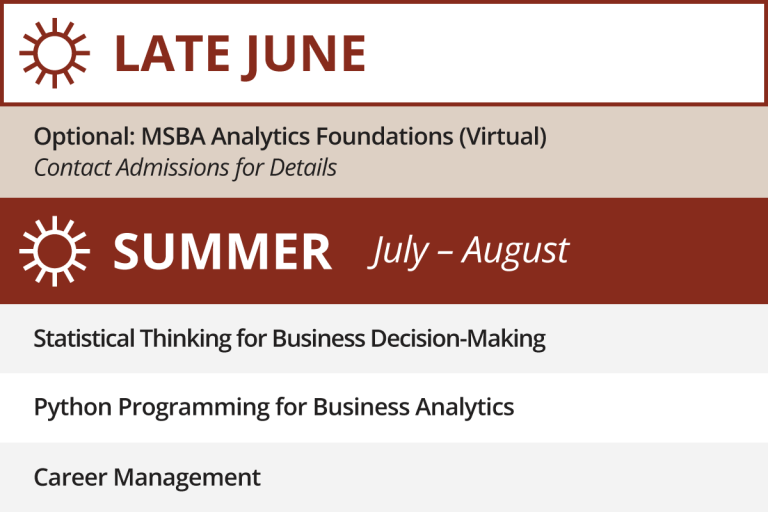
Statistical Thinking for Business Decision-Making (3 Credit Hours)
Decision-making situations involve varying levels of uncertainty. This course introduces methods for modeling and informing decision-making under uncertainty. Topics include probability theory, probability distributions, confidence intervals, hypothesis testing, analysis of variance, and linear regression with an emphasis on practical applications in business contexts and spreadsheet modeling.
Career Management (1.5 Credit Hours)
You have made an important decision to pursue an MS in Business Analytics (MSBA) to position yourself for a career in the field. Overall, the marketplace is becoming increasingly competitive, and while the MSBA will offer a significant differentiator, your ultimate success in obtaining a job that aligns with your career aspirations is heavily dependent on the critical steps you take toward career planning and preparation. Understanding career paths in Business Analytics and developing lifelong career management skills are the objectives of this class.
Python Programming for Business Analytics (3.0 Credit Hours)
Due to its power, simplicity, and open-source availability, the Python programming language has become one of the leading data analytics languages across a wide variety of organizations and industries. This course focuses on developing a strong foundation in Python programming for business analytics applications. Students will learn essential programming concepts and techniques including variables, data structures, loops, functions, and automation. Additionally, they will explore the use of Python libraries for data analysis, manipulation, and visualization.
Fall Semester
Starting in late August, the Fall semester consists of a combination of semester-long courses and two mini modules that examine the relationship among data, business analytics, and organizational performance in greater depth.
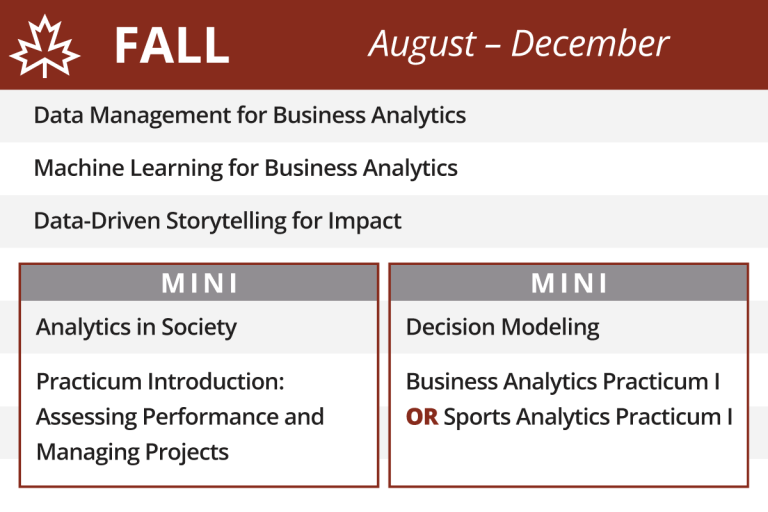
Data Management for Business Analytics (3 Credit Hours)
As a result of our interconnected digital ecosystem, businesses are inundated with vast streams and quantities of data. As data volumes grow and cloud services become the backbone of data infrastructure, there’s a pressing need for professionals who understand the nuances of managing in this new data landscape. This hands-on course delves into contemporary techniques and tools for effective data management in today’s digital ecosystem. Topics include SQL, relational databases, database design, cloud services, APIs, data integration, and big data systems, providing students with practical skills for managing and analyzing large volumes of data.
Machine Learning for Business Analytics (3.0 Credit Hours)
Machine learning is at the forefront of modern technology and powers many applications and systems that we interact with daily, such as recommendation systems, virtual assistants, and autonomous vehicles, to name a few. This course introduces predictive modeling techniques with a focus on the implementing machine learning algorithms for business analytics applications. Topics include linear and logistic regression, classification trees, clustering, random forest, gradient boosting, KNN, collaborative filtering, recommendation engines, neural networks, and explainable machine learning, equipping students with essential skills for leveraging data-driven insights.
Data-Driven Storytelling for Impact (3.0 Credit Hours)
Becoming a successful analytics practitioner who can drive impact within an organization requires the ability to effectively communicate with all levels of the organization. This course focuses on leveraging data visualization and storytelling techniques to effectively communicate analytical insights and drive impact within organizations. Students will learn best practices for data storytelling and visualization, enabling them to present complex analyses in a compelling and influential manner.
Decision Modeling (1.5 Credit Hours)
Decision Modeling focuses on the application of disciplined, well-structured, and logical problem-solving processes to support decision-making. Such processes include correctly defining and framing the business problem/opportunity, applying appropriate analytical tools and methodologies to model the situation, and utilizing the models to gain keen insights to support decisions that make a positive impact to organizations and society. Topics addressed include advanced spreadsheet modeling, optimization, decision theory, and Monte Carlo simulation, providing students with practical skills for solving complex business problems.
Analytics in Society (1.5 Credit Hours)
The increased focus on data, data collection, and analytics requires managers to form a deep understanding of the policy and ethical implications of their use of analytics for making decisions. This course explores the ethical, legal, and policy implications of using analytics in decision-making. Topics include ethics in big data, privacy concerns, security issues, and regulatory compliance, enabling students to navigate ethical challenges and promote responsible use of analytics and AI in organizations.
Practicum Introduction: Assessing Performance and Managing Projects (1.5 Credit Hours)
Beyond being proficient in business analytics methodologies, success as a business analytics professional requires an understanding of how business analytics supports the broader mission of the organization and its strategy. This course focuses on the important relationships between data, business analytics, and organizational performance. Topics include project management, teamwork dynamics, and aligning analytics initiatives with organizational goals, preparing students for real-world business analytics projects.
Business Analytics Practicum I (1.5 Credit Hours)
This course provides students with the opportunity to apply their business analytics skills to a real-world project. In this course, student teams collaborate with corporate partners to address a real-world business problem. Working with a faculty mentor, students apply analytical techniques and methodologies necessary to address the identified business challenges.
Sports Analytics Practicum I (1.5 Credit Hours)
In this practicum, students apply their analytics skills within the dynamic environment of the sports industry. Student teams are embedded with an athletic team or sports organization and support real-time, evolving analytical needs throughout the season. Students engage directly with coaches, performance staff, or front-office personnel to address operational and strategic questions using relevant data streams. Faculty mentors provide guidance as students apply analytical techniques, develop actionable insights, and contribute to decision-making in a fast-paced, performance-driven setting.
Spring Semester
In early January, students continue to develop models for forecasting, optimization, and yielding actionable intelligence and explore multi-industry applications of data analysis. Students also finish the three-course team-based practicum and present their findings.
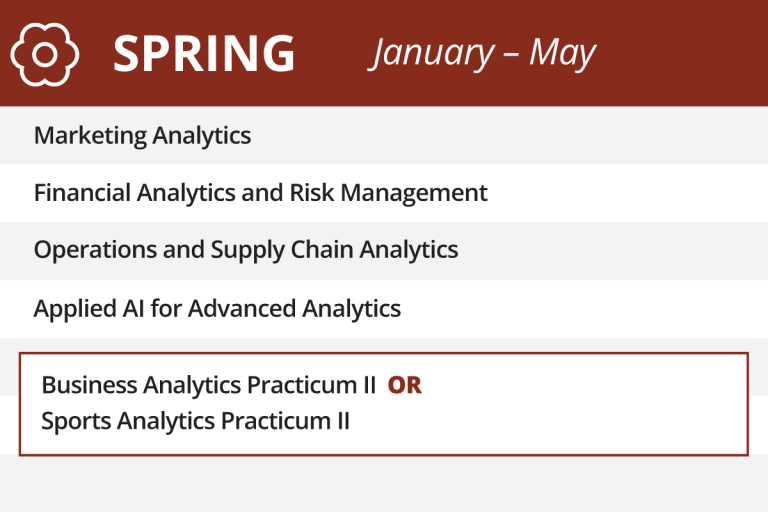
Marketing Analytics (3 Credit Hours)
Marketing analytics allows businesses to make data-driven decisions by providing insights into customer behavior, preferences, and trends. By analyzing data from various sources such as website traffic, social media engagement, and sales transactions, organizations can identify effective marketing strategies and allocate resources more efficiently. This course explores the collection, analysis, and interpretation of marketing data to drive data-driven marketing strategies. Topics include market segmentation, perceptual mapping, A/B testing, web analytics, and online advertising, with a focus on leveraging digital data to inform marketing decisions.
Financial Analytics and Risk Management (3 Credit Hours)
This course covers financial modeling and how to measure and manage risk through descriptive statistics, probability theory, optimization, regression analysis, decision trees, and simulation analysis. Topics covered include time value of money, bond and stock valuation, portfolio theory, financial statement analysis, capital budgeting analysis, and real option valuation, providing students with essential skills for identifying and managing financial risks effectively.
Operations and Supply Chain Analytics (3 Credit Hours)
It is widely accepted that the environment confronting organizations today is becoming increasingly competitive as the length of product life cycles continue to decrease, the marketplace becomes increasingly global, and the pace of technological change accelerates. As a result, most, if not all, organizations are seeking ways to continuously improve their business processes, to produce and deliver their products/services more efficiently, and to meet their customer needs more effectively in their pursuit of attaining a sustainable competitive advantage. This course examines the application of business analytics methodologies to improve operations and business processes and design effective supply chains. Topics include discrete event simulation for process analysis and improvement, inventory management, supply chain network design and optimization, enabling students to enhance efficiency and meet customer needs effectively.
Applied AI for Advanced Analytics (3.0 Credit Hours)
This course explores cutting-edge AI tools and techniques – beyond generative models – to equip students with advanced capabilities in automation, analytics, and decision-making. The course begins with the foundational architecture of large language models and explores how they can be adapted to business applications. Next, the use of AI to enhance productivity and analytical capabilities is explored. Best practices for AI development are subsequently discussed. Finally, how to integrate AI across the enterprise is discussed.
Business Analytics Practicum II (3 Credit Hours)
This course is a continuation of the Business Analytics Practicum I course and as such students continue to apply their business analytics skills to a real-world project. Student teams continue to collaborate with corporate partners to address a real-world business problem. Faculty mentors continue to guide students as they apply analytical techniques and methodologies necessary to address the identified business challenges.
Sports Analytics Practicum II (3 Credit Hours)
In this practicum, students continue applying their analytics skills within the dynamic environment of the sports industry. Student teams are embedded with an athletic team or sports organization and support real-time, evolving analytical needs throughout the season. Students engage directly with coaches, performance staff, or front-office personnel to address operational and strategic questions using relevant data streams. Faculty mentors provide guidance as students apply analytical techniques, develop actionable insights, and contribute to decision-making in a fast-paced, performance-driven setting.
Summer Semester II
(Optional Sports Analytics Concentration)
Students pursuing the new Sports Analytics concentration will complete an additional online summer semester designed to deepen their expertise in the analytics shaping modern sports organizations. Across two specialized courses, they will apply advanced modeling, AI, and data engineering techniques to real-world sports data—connecting player and team performance insights with front office, fan engagement, and strategic decision-making.
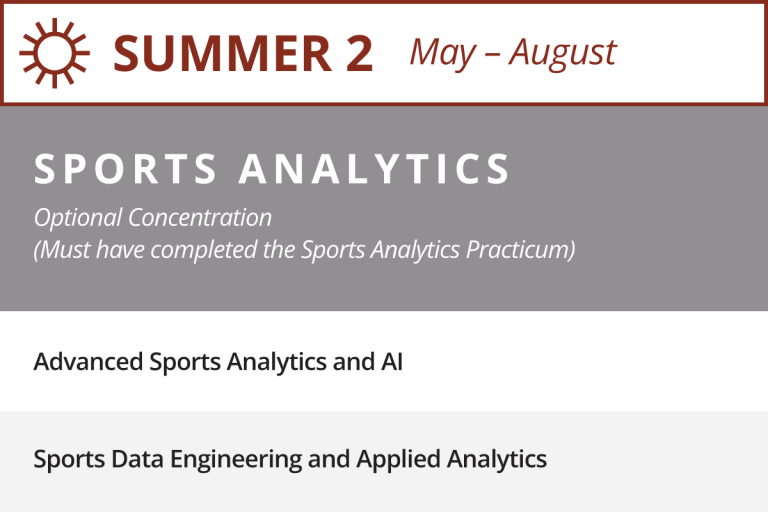
Advanced Sports Analytics and AI (3 Credit Hours)
This course explores advanced statistical and machine learning approaches to player and team performance, while also introducing select applications on the front office and business side of sports. Students will learn to work with time series data, build and evaluate Bayesian models, and apply advanced machine learning models and AI for analyzing and predicting player performance and development, injury risk, and game outcomes. Applications extend to topics such as roster optimization, game strategy modeling, ticket pricing, player salaries, and fan engagement prediction. Applications of optimization and simulation to decision-making are also addressed.
Sports Data Engineering and Applied Analytics (3 Credit Hours)
This course focuses on the acquisition, integration, and management of diverse, messy, and high-velocity sports data. Students will work with ticketing systems, fan engagement metrics, player tracking, video logs, biometric/wearable data, and CRM systems. Emphasis is placed on building end-to-end workflows: data ingestion, cleaning, storage, integration, and pipeline automation. Students will repeatedly carry datasets forward into modeling and visualization activities, mirroring real-world analytics practice. The course also introduces cloud-based data solutions and APIs for live game feeds. Additionally, the course emphasizes the use of open-source dashboarding tools such as R Shiny, Streamlit, and Plotly to create interactive applications tailored to the needs of coaching staffs and front office operations.
Note: Program and curriculum are subject to minor changes.

